
This insight is open to all subscribers and registered users, or available by completing the form.
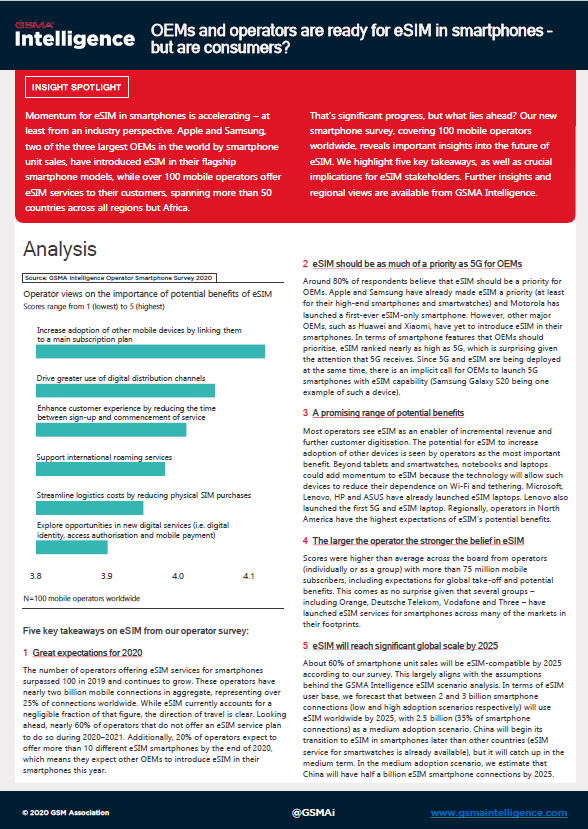
Momentum for eSIM in smartphones is accelerating – at least from an industry perspective. Apple and Samsung, two of the three largest OEMs in the world by smartphone unit sales, have introduced eSIM in their flagship smartphone models, while over 100 mobile operators offer eSIM services to their customers, spanning more than 50 countries across all regions but Africa.
That’s significant progress, but what lies ahead? Our new smartphone survey, covering 100 mobile operators worldwide, reveals important insights into the future of eSIM. We highlight five key takeaways, as well as crucial implications for eSIM stakeholders. Further insights and regional views are available from GSMA Intelligence.
Report details
The future of eSIM in smartphones: are we at a turning point?
Download the report
Complete the form to get instant access to this content. For easier access in the future, you can register for a free account here.
By submitting this form, you agree that your email address and related activity on the platform will be processed for the purpose of generating and providing the requested report. Your data will be shared with GSMA Intelligence for this purpose. For more information, please see the GSMA Intelligence Privacy Policy.
Report details
The future of eSIM in smartphones: are we at a turning point?
Download the report
Complete the form to get instant access to this content. For easier access in the future, you can register for a free account here.
By submitting this form, you agree that your email address and related activity on the platform will be processed for the purpose of generating and providing the requested report. Your data will be shared with GSMA Intelligence for this purpose. For more information, please see the GSMA Intelligence Privacy Policy.
Related research
Identity for AI agents: understanding operators' early moves and the business opportunity ahead
Use of AI agents is set to increase exponentially. But as AI agents become the norm, work alongside humans and make decisions, the need for verifiable, manageable and secure identities becomes critical to ensure digital trust. Identity and access management is not a new business for operators. However, its extension to AI agents brings new opportunities. This report analyses the technical options for AI agent identity, what pioneer operators are doing today, and the future business opportunities.
World Cup 2026: are operators the game-changers?
The 2026 Fifa World Cup in Canada, Mexico and the US is set to capture the attention of football fans around the world, with operators playing a significant role in its success. The event in many ways represents a microcosm of operator strategy: combining infrastructure performance, customer experience and service innovation to meet immediate demand and strengthen long-term competitive positioning.
Industry Checkpoint: MVNOs, Q2 2026
This edition of the Industry Checkpoint series focuses on the MVNO segment, highlighting how the market has changed in the last six months and its implications. The report considers four major developments: renewed momentum behind brand-affinity MVNOs, the use of eSIM for consumer offerings, the rise of converged connectivity propositions from fixed broadband providers, and adoption of AI across the MVNO segment.
Authors
How to access this report
Annual subscription: Subscribe to our research modules for comprehensive access to more than 200 reports per year.
Enquire about subscriptionContact our research team
Get in touch with us to find out more about our research topics and analysis.
Contact our research teamMedia
To cite our research, please see our citation policy in our Terms of Use, or contact our Media team for more information.
Learn more- 200 reports a year
- 50 million data points
- Over 350 metrics
How can we support you?
Get in touch
Contact the GSMA Intelligence support team for help with your account, subscriptions, or access to reports and insights.
Newsletter
Subscribe to the GSMA Intelligence newsletter for the latest industry news and insights, delivered to your inbox.