
Sovereign Digital Services: Where telcos are playing, in India and Beyond
Author
I attended the India Mobile Congress 2026 with my GSMA Intelligence colleagues, trying to get a pulse of where the industry is heading and curious to see how closely the priorities of Indian operators align with what we are observing globally. India is an interesting market to watch. Beyond the scale of its telecom market, there is a growing ambition to build indigenous technology capabilities and play a bigger role in the global digital ecosystem.
And there was plenty to see. From network slicing and indigenous radio solutions to voice AI, spam and fraud prevention, and AI-powered networks, Indian operators are working across several areas that are also high on the global telecom agenda. But two interrelated themes particularly caught my attention: satellite connectivity and and the growing push for digital autonomy.
Jio was showcasing plans for a sovereign constellation of 1,600 satellites, while Airtel was showcasing its operational sovereign cloud and data centre capabilities at Manesar, Gurgaon reportedly serving 40+ enterprise customers. BSNL Tower Corporation (BTCL) and Submer India also signed an MoU to explore AI-ready infrastructure, including GPU-as-a-Service, edge facilities and data centres of up to 20 MW.
But India's push for greater control over its digital infrastructure and services did not begin at IMC. Reliance Jio had already announced plans for 120 MW of AI compute capacity at Jamnagar during its AGM, while investments under the government's IndiaAI Mission and the development of homegrown AI models such as Sarvam and BharatGen reflect a broader national ambition.
And this is not just an India story.
Our recently published GSMA Intelligence report, Telcos and sovereignty: state of the market, highlights that sovereignty-related announcements from telcos globally to bolster their domestic capabilities quadrupled between 2024 and 2025. By the end of August 2026, we had identified 102 initiatives from 64 operators across 40 markets.
Where do telcos really fit in?
In my earlier blog, Sovereign Enough, I argued that being sovereign is not about controlling everything. Across several layers – data residency and localisation, infrastructure (EG data centres, cloud, compute and AI factories), models and applications – it is about understanding critical dependencies and deciding where greater control matters, particularly amid geopolitical uncertainty and supply chain disruption. No operator needs to participate in all of them to play a meaningful role.
And telcos are not starting from scratch here. They already operate national networks, have established infrastructure footprints, work in highly regulated environments and maintain long-standing relationships with governments and enterprises. Many also have existing data centre and cloud capabilities, alongside partnerships with hyperscalers and technology vendors. These strengths put them in a position to participate across different parts of the stack, although not necessarily in every layer or to the same extent. This is exactly what our research is also beginning to show.
Not all layers are moving at the same pace
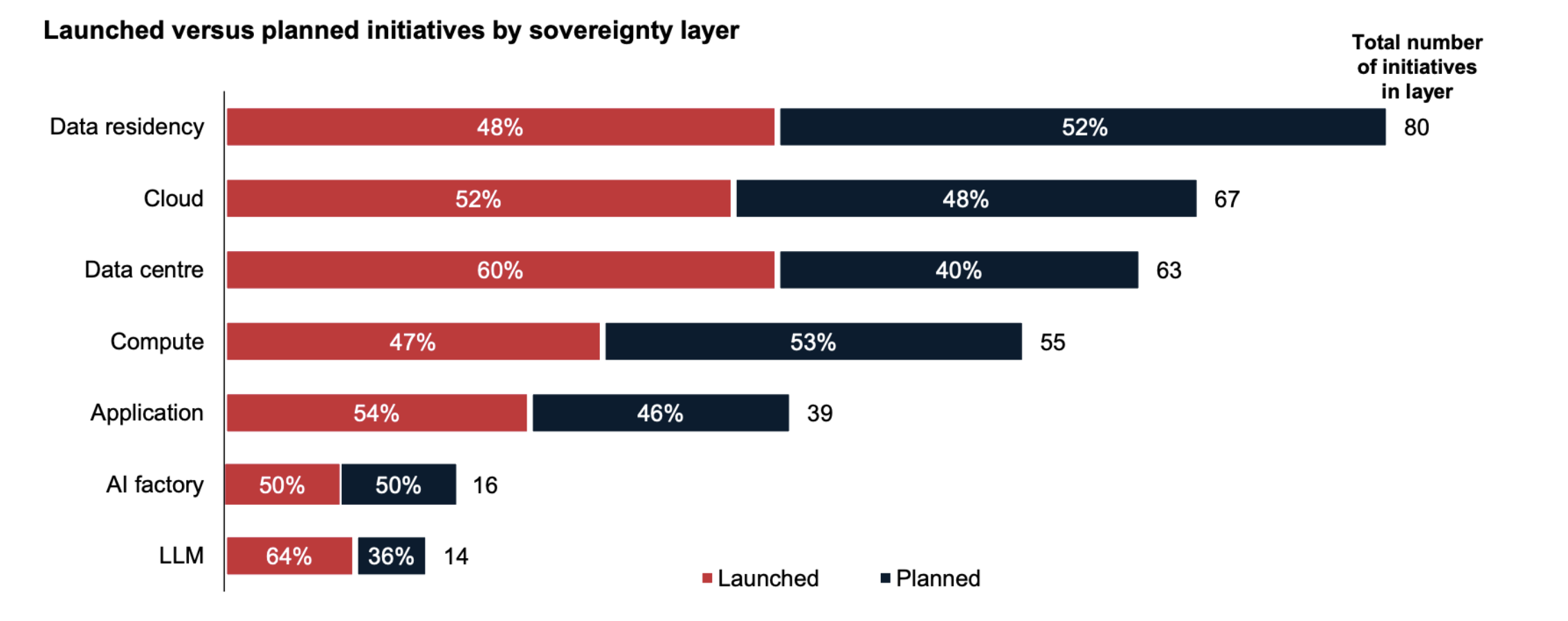
One of the interesting findings from our research is that telco activity is currently more concentrated around data residency, data centres and cloud, with growing participation in compute and AI-related infrastructure.
For many operators, particularly the larger ones, data centres and cloud are a natural extension of capabilities they have already built for their own businesses. The opportunity now is to extend those capabilities to enterprises and regulated industries looking for greater control over where their data resides and how it is managed. In some ways, these are also the foundations on which more advanced sovereign capabilities, can be built. As those foundations mature, we are beginning to see activity expand towards compute, AI factories and other parts of the AI value chain.
But this natural expansion does not necessarily apply to LLMs. Our research suggests that participation in local models is much more dependent on local market conditions. Language diversity, national priorities, demand for locally relevant models and the availability of compute all influence whether such investments make commercial and strategic sense. For example, in markets where global models may not adequately serve local languages, there can be a stronger case for developing local models. Equally, operators may find opportunities in smaller, specialised models designed for particular enterprise or industry requirements.
The point is that participating across the stack does not mean every operator needs to operate across every layer. Deployment maturity will also vary: building sovereign infrastructure is capital-intensive, and operators with greater investment capacity may move faster.
Who will pay for it?
While these solutions could eventually serve many industries, our research and GSMA Intelligence's Telco AI attitudes survey suggest initial demand will be anchored by governments, regulated industries and mission-critical organisations. This is hardly surprising. Given the strategic importance of data control, resilience and reducing external dependencies, governments were always likely to be among the first customers.
But the opportunity is not limited to these early adopters. According to GSMA Intelligence Enterprise in Focus survey, every four in ten enterprises see telcos as potential suppliers of these solutions. More interestingly, Indian enterprises are willing to pay an average premium of 15% for locally developed and controlled technology, rising to 17% for cybersecurity solutions.
And that is where the commercial opportunity for telcos starts to become clearer.
So, what comes next?
Telcos clearly have an advantage in this space, but having an advantage and turning it into a sustainable business opportunity are two different things. The real opportunity lies in building on their existing strengths, identifying the layers where they should operate and translating their trusted relationships into enterprise adoption.
For governments, the role is equally important. Beyond policy and regulation, they can help create the initial demand and investment certainty needed for sovereign infrastructure and services to scale. Because ultimately, no single player can deliver this vision alone. It will require governments, telecom operators, technology companies and enterprises to work together, each bringing different capabilities to the table. And perhaps that is the larger message emerging from our research.
For telcos, the opportunity is not necessarily to own or control every layer of the technology stack. It is to become a trusted partner in helping countries and enterprises gain greater control over the digital capabilities that matter the most.
How can we support you?
Get in touch
Contact the GSMA Intelligence support team for help with your account, subscriptions, or access to reports and insights.
Newsletter
Subscribe to the GSMA Intelligence newsletter for the latest industry news and insights, delivered to your inbox.

- 200 reports a year
- 50 million data points
- Over 350 metrics
How can we support you?
Get in touch
Contact the GSMA Intelligence support team for help with your account, subscriptions, or access to reports and insights.
Newsletter
Subscribe to the GSMA Intelligence newsletter for the latest industry news and insights, delivered to your inbox.