
Sovereign enough: navigating the limits of independence in telecoms and tech

Alongside the evolution of Gs, the telecom and tech industry feeds on a new “hot topic” every year or two. Looking back over the last five years, industry discussions have shifted from the metaverse in 2020, to Open RAN, to AI, and now to sovereignty. Some of these themes, like AI, have sustained momentum, while others have faded after the initial wave of excitement.
In a world shaped by persistent geopolitical uncertainty and global supply chain disruptions, the concept of sovereignty presents a compelling narrative. The logic feels straightforward—control is seen as directly linked to sovereignty. The more sovereign you are, the greater the control you have, and the less dependent you become on global partners.
And that’s exactly where a more nuanced understanding becomes essential.
Not because control is an unrealistic objective but because sovereignty's real goal was never absolute control to begin with.
At its core, sovereignty is neither binary nor absolute. It is increasingly emerging as a layered construct, shaped by diverse approaches that align with national priorities. And it is this layering that ultimately defines the degree of control a nation seeks to exert in pursuance of their sovereignty goals.
At GSMA Intelligence, we have been tracking developments around sovereignty across telecom operators, hyperscalers, and national strategies. What is emerging from the data is a more nuanced picture, one that highlights the distinctions across different layers of sovereignty, and how control and independence vary within each.
Data sovereignty and the role of trusted partnerships
The complexity begins at the data layer itself. A number of developments globally involve partnering with hyperscalers and cloud providers to establish local data hosting, residency, and processing, and touting these as data sovereignty wins. But the deeper question is rarely asked: who actually controls that infrastructure when it matters? Who decides when something goes wrong, and does any of this align with local regulatory frameworks?
A dataset can sit within national borders and still be governed by external systems. Physical location creates assurance; it does not automatically create autonomy.
The answer here is not to avoid partnerships. In many cases, they are the right model, especially where governance frameworks are clear and trust is established. The real question is whether a partnership is structured to meet sovereignty objectives, not whether one exists at all.
Infrastructure sovereignty in a global ecosystem
The next layer that is emerging is infrastructure. This includes solutions being built and positioned as sovereign infrastructure capabilities, such as local data centres, AI factories, local compute, GPU-as-a-service offerings, and enterprise platforms to train and test AI models. Many of these developments focus on localising storage and compute, but are still powered by external dependencies, whether in the form of silicon, software, memory chips, or other critical components of the hardware and software stack. The infrastructure may appear local, but the foundations it relies on are often not. That does not invalidate these efforts but it does highlight that sovereignty at this layer is shaped as much by partnerships and supply chains as by physical location.
Model sovereignty and local capability building
The third emerging layer is that of local models and LLMs. In many cases, the concept of a local LLM involves training models on local datasets and tailoring them for local use cases. This represents a more direct form of control, particularly where data, training, and deployment are aligned with local priorities. However, even here, the picture is not entirely straightforward. Where inferencing takes place, and the infrastructure supporting it, plays a crucial role in determining how sovereign these models truly are, bringing us back once again to the dependencies embedded within the infrastructure layer.
All three layers are underpinned by governance, policy frameworks, and the effectiveness with which they are implemented. The availability of local skills and talent also plays a defining role in shaping a country’s sovereignty position. Something built for local use with data stored and processed locally, using local systems, can still create a false sense of sovereignty if the underlying expertise and capabilities are not domestically rooted.
The below graph illustrates how the activities of telcos are currently distributed across the three layers.
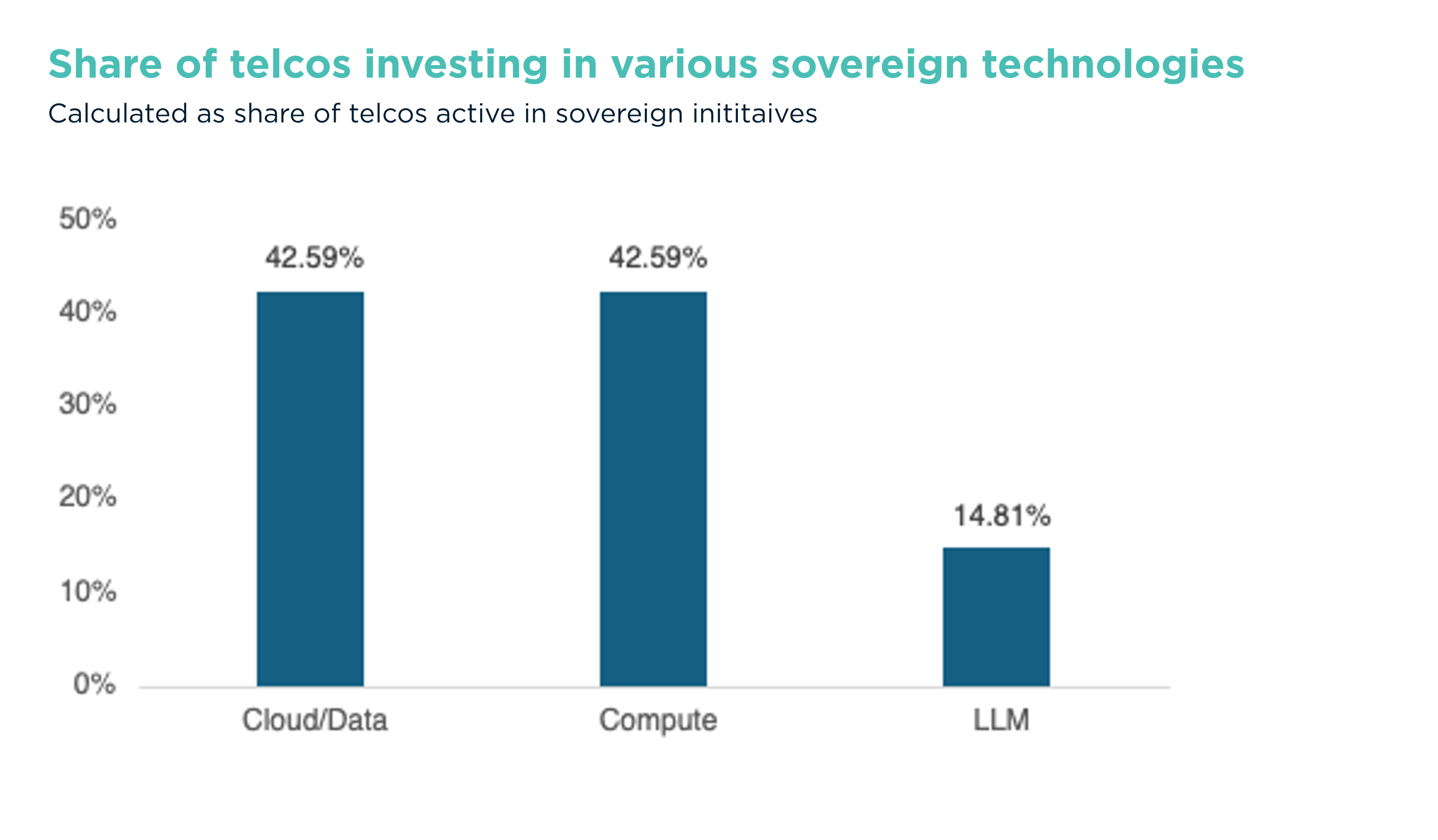
Source: GSMA Intelligence sovereignty tracker
The telecom paradox
This is where telecom sits at the centre of these discussions. In an increasingly digital world powered by connectivity, telecom is widely regarded as critical national infrastructure central to economic growth, national security, and digital inclusion. As a result, telecom operators are often seen as trusted partners in achieving sovereignty goals.
And that notion of trust becomes critical. Because at the same time, telecom and digital technologies have evolved through decades of global collaboration. Supply chains are international, innovation is distributed, and interoperability depends on shared standards. Interdependence is not an exception, it is the foundation of telecom architecture.
And this creates a fundamental shift on how you define sovereignty. You cannot fully decouple from global ecosystems, but you cannot fully rely on those partners and external supply chains in today's uncertain geopolitical environment.
Rethinking sovereignty
So what does this mean?
Does the idea of sovereignty disappear? Unlikely. If anything, sovereignty will become even more important as digital systems continue to underpin economies and societies. But perhaps its definition will evolve. If the underlying goal of sovereignty is to protect against global uncertainties and supply chain disruptions, then the intent was never absolute control, it was resilience and a degree of trusted control.
The lens through which we view sovereignty needs to shift—from control to resilience, and from independence to informed interdependence. In this sense, sovereignty becomes less about owning every layer of the stack, and more about understanding where control truly matters. It is about asking the right questions –
Where are the critical dependencies? Which capabilities need to be prioritised? And where does it make sense to lead versus partner?
The goal is not to achieve perfect independence, but to build resilience through trust by working with trusted providers and partners where full sovereignty is impractical, while retaining genuine control where it matters most. Because in a connected world, sovereignty is not about standing apart. It is about understanding the system you are part of, knowing which parts of it you can trust, and shaping the conditions under which that trust is earned and maintained.
Author

- 200 reports a year
- 50 million data points
- Over 350 metrics
How can we support you?
Get in touch
Contact the GSMA Intelligence support team for help with your account, subscriptions, or access to reports and insights.
Newsletter
Subscribe to the GSMA Intelligence newsletter for the latest industry news and insights, delivered to your inbox.