
Mobile phone circularity: growing momentum, with financial incentives a driving force
Access this insight with a Premium plan. Contact our sales team to get started.
Or
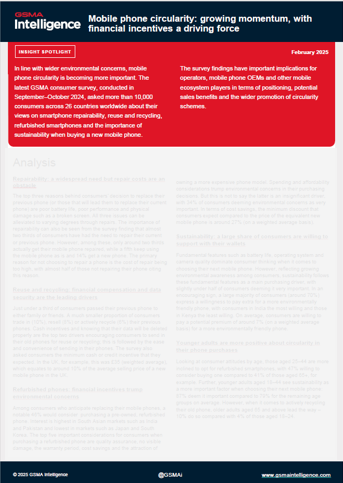
Environmental concerns are rising and improving device circularity is an important part of climate-change mitigation efforts. In this report we draw upon the latest GSMA consumer survey of more than 10,000 consumers in 26 countries to understand consumer behaviour with regard to mobile phone circularity, including repairability, reuse and recycling, refurbished devices and the importance of sustainability in mobile phone purchases. Operators are the leading mobile phone retailers in many markets globally and this puts them in an important position to advance the cause of mobile phone circularity, along with mobile phone OEMs.
Report details
Mobile phone circularity: growing momentum, with financial incentives a driving force
More info
This report is one of more than 140 published annually as part of the GSMA Intelligence data and research subscription, which is designed for organisations that require regular access to our insights. Contact our sales team for details.
Contact usReport details
Mobile phone circularity: growing momentum, with financial incentives a driving force
More info
This report is one of more than 140 published annually as part of the GSMA Intelligence data and research subscription, which is designed for organisations that require regular access to our insights. Contact our sales team for details.
Contact usRelated research
Apple's event shines a light on four areas of innovation, with the biggest test in foldables
Apple held its Surprise and Shine event earlier this month, unveiling its latest range of devices. The standout was the much-anticipated foldable iPhone Duo, combining top-end specifications with what appeared to be a refined user experience. In this report, we dissect Apple’s new product developments and innovations from the event while assessing what they mean for the wider mobile industry.
Defining themes at IFA 2026: AI transforms devices and humanoids step forward
At IFA Berlin 2026, AI remained the dominant theme, as it becomes increasingly embedded across consumer electronics experiences. Beyond AI, robotics stood out, with the show hosting a ‘Robots on the Runway’ spectacle. For players across the consumer tech ecosystem, the themes highlighted at IFA continue to spur opportunities such as monetisation but also challenges, including costs and privacy issues.
Smartphone competition in 2026 and beyond: regional dynamics matter more than global share
As smartphone competition becomes increasingly shaped by regional dynamics, understanding competitive dynamics beyond the global level is becoming more important. This report examines smartphone competition through a regional lens, highlighting leaders, followers and challengers across regions and countries. The insights can be used to formulate or adjust commercial strategies, identify growth opportunities and prioritise markets.
Authors
How to access this report
Annual subscription: Subscribe to our research modules for comprehensive access to more than 200 reports per year.
Enquire about subscriptionContact our research team
Get in touch with us to find out more about our research topics and analysis.
Contact our research teamMedia
To cite our research, please see our citation policy in our Terms of Use, or contact our Media team for more information.
Learn more- 200 reports a year
- 50 million data points
- Over 350 metrics
How can we support you?
Get in touch
Contact the GSMA Intelligence support team for help with your account, subscriptions, or access to reports and insights.
Newsletter
Subscribe to the GSMA Intelligence newsletter for the latest industry news and insights, delivered to your inbox.