
FMC: Europe continues to lead as operators seek new growth beyond quad play
Access this insight with a Premium plan. Contact our sales team to get started.
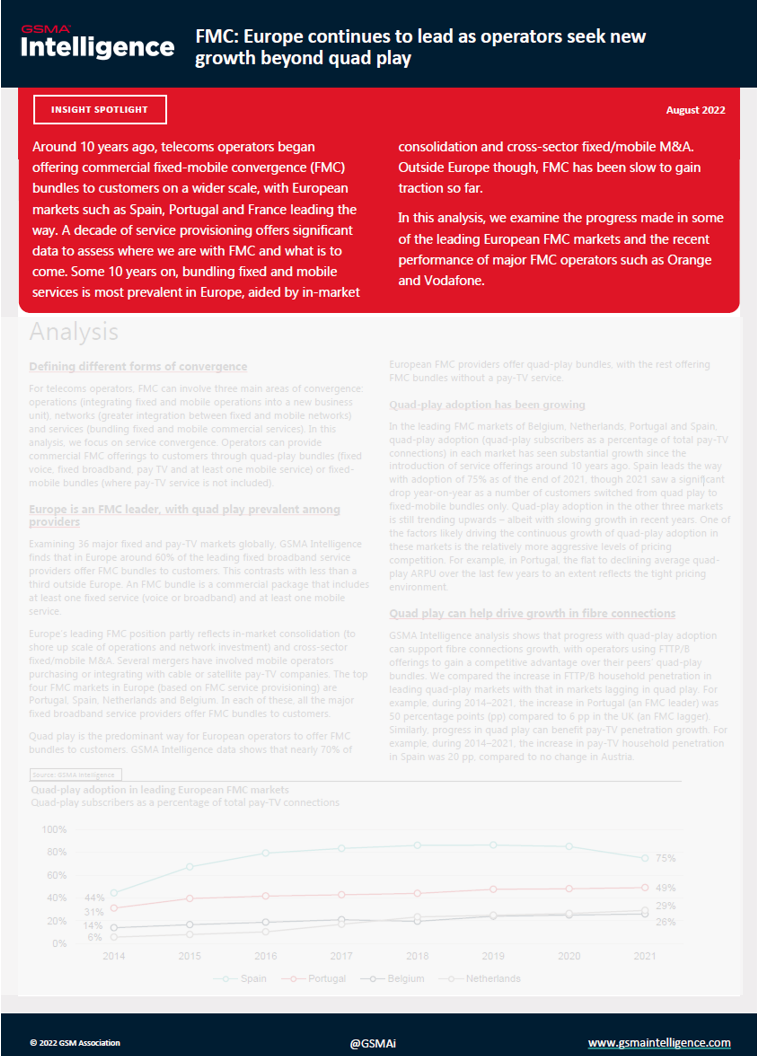
Around 10 years ago, telecoms operators began offering commercial fixed-mobile convergence (FMC) bundles to customers on a wider scale, with European markets such as Spain, Portugal and France leading the way. A decade of service provisioning offers significant data to assess where we are with FMC and what is to come. Some 10 years on, bundling fixed and mobile services is most prevalent in Europe, aided by in-market consolidation and cross-sector fixed/mobile M&A. Outside Europe though, FMC has been slow to gain traction so far.
In this analysis, we examine the progress made in some of the leading European FMC markets and the recent performance of major FMC operators such as Orange and Vodafone.
Report details
FMC: Europe continues to lead as operators seek new growth beyond quad play
Report details
FMC: Europe continues to lead as operators seek new growth beyond quad play
Related research
Unreliable connection is the top reason for dissatisfaction among fixed broadband users across most major markets
From the shape and size of markets to trends in consumer behaviour, GSMA Intelligence aims to provide food for thought through informative visuals designed to bring colour and clarity to complex issues facing the industry. This chart highlights how an unreliable connection is the top reason for dissatisfaction among fixed broadband users across most major markets.
South Korea's internet traffic regulations
South Korea is a connectivity leader: it scores as a top performer across various metrics relating to network quality and intensity of use. However, the country attracted international attention in 2016 when it moved to a new model of governing interconnections between the largest network operators. Nearly 10 years since, the regulation model still attracts attention and commentary. We revisit the case of South Korea and examine the real-world impacts regulation had using data on key consumer indicators and how the country has fared against peers.
Pay-TV Markets, Q2 2026: developments and outlook
Pay-TV markets are seeing an unprecedented evolution, driven by technology investments, shifting consumer behaviour and competition (including from OTT players). This quarterly series outlines the latest market developments and the key trends to watch, charting the period to 2030. The report also provides comprehensive cross-country comparisons at your fingertips, allowing you to identify which markets or technologies will grow the most or how OTT competition will impact the adoption of traditional pay TV.
Authors
How to access this report
Annual subscription: Subscribe to our research modules for comprehensive access to more than 200 reports per year.
Enquire about subscriptionContact our research team
Get in touch with us to find out more about our research topics and analysis.
Contact our research teamMedia
To cite our research, please see our citation policy in our Terms of Use, or contact our Media team for more information.
Learn more- 200 reports a year
- 50 million data points
- Over 350 metrics
How can we support you?
Get in touch
Contact the GSMA Intelligence support team for help with your account, subscriptions, or access to reports and insights.
Newsletter
Subscribe to the GSMA Intelligence newsletter for the latest industry news and insights, delivered to your inbox.