
What made headlines in the MVNO landscape in the month of June: Is Nigeria’s MVNO market finally gaining traction?

Author
MVNO activity continues to build momentum across markets, with a growing number of partnerships and regulatory initiatives shaping how the industry evolves. In June, one of the more notable developments came from Nigeria, where recent agreements and policy interventions suggest the market may be entering a phase of commercial launches.
Forty-six MVNO licences. That is how many licenses Nigeria's telecoms regulator has issued since 2023. Yet by the end of Oct’ 25, just two of those 46 had launched commercial services. The primary reasons underpinning these delays are the challenges in securing wholesale agreements and the licensees lacking operational expertise and financial capital required to launch and scale MVNO services.
A recent development signalling potential progress is the wholesale agreement between IMBIL Telecom, a global MVNE, and Airtel Nigeria. The agreement may mark a turning point for the market, addressing two key barriers simultaneously. As an MVNE, IMBIL provides the infrastructure and operational capabilities required to support MVNO launches, easing the entry for licensees. In addition, IMBIL’s plans to operate as both an MVNE and MVNA could further streamline market entry by reducing the need for MVNOs to negotiate directly with host operators. With five MVNOs already signed to its platform, near-term activity is expected to pick up.
From the mobile operator perspective, Airtel’s participation in this wholesale agreement signals a potential strategic shift. By enabling MVNOs, Airtel could increase network utilization and diversify revenue through wholesale streams. This increases the likelihood that other operators, particularly MTN, would consider similar approaches.
Another key development aimed at accelerating MVNO launches is the Nigerian Communications Commission’s (NCC) draft of Business Rules for MVNOs. The proposed guidelines seek to address one of the main barriers to market entry, securing wholesale access agreements by introducing clearer timelines and requirements for host MNOs.
Under the draft framework, host operators are required to acknowledge MVNO access requests within 10 days and provide a full technical and commercial response within 20 days. If a request is rejected, a detailed written explanation must be submitted to both the MVNO and the regulator. Importantly, internal factors such as corporate restructuring or network expansion plans cannot be used to justify delays. The proposed rules also include provisions for standardised benchmark pricing and clearer MNO–MVNO revenue-sharing arrangements.
Collectively, these measures are intended to create a more enabling environment for MVNOs by improving transparency and reducing delays in the approval process. However, the framework remains under review, with inputs pending from industry stakeholders, including telecom operators, before the final implementation.
Ultimately, the extent to which MVNOs are able to scale and capture market share in Nigeria will depend on a broader set of factors, including execution capabilities, market positioning and underlying customer demand. While regulatory and commercial developments are important enablers, they represent only part of the conditions required for a sustainable MVNO market.
Sustained growth in Nigeria’s MVNO market will depend not only on improved access and regulatory support, but also on the ability of MVNOs to identify and serve unmet customer demand. With Nigerian MNOs already operating at relatively low ARPU levels (around $2.95, compared to a global average of $8.51), the scope for price-based competition remains constrained. In a low-ARPU environment, scale will be difficult to achieve through price competition alone, placing greater emphasis on differentiation and niche targeting. How effectively the upcoming players translate licenses into differentiated value propositions will determine whether recent developments lead to sustained market traction.
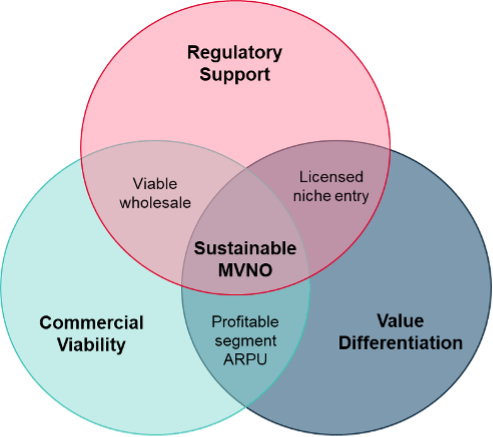
Figure.1: An MVNO scales only where all three overlap, Nigeria is still mostly in red ring.
The latest developments indicate that the market is moving towards enabling MVNO entry, through greater clarity on wholesale access, while improving the conditions for commercial viability. This makes the coming years critical in determining how the MVNO landscape evolves in Nigeria.
For further insights, see our latest MVNO Industry Checkpoint, which tracks key developments over the past six months, and our MVNO State of the Market report , which provides a more detailed assessment of business models and the wider ecosystem.
How can we support you?
Get in touch
Contact the GSMA Intelligence support team for help with your account, subscriptions, or access to reports and insights.
Newsletter
Subscribe to the GSMA Intelligence newsletter for the latest industry news and insights, delivered to your inbox.

- 200 reports a year
- 50 million data points
- Over 350 metrics
How can we support you?
Get in touch
Contact the GSMA Intelligence support team for help with your account, subscriptions, or access to reports and insights.
Newsletter
Subscribe to the GSMA Intelligence newsletter for the latest industry news and insights, delivered to your inbox.