
The Engagement Dilemma (Part 2): ALREADY Engaged

Who defines the terms of engagement?
In the first part of this series, I explored why the satellite conversation is no longer simply a Starlink story. That naturally raises the next question: if this is no longer just a Starlink story, what exactly does the newly announced JV between AT&T, T-Mobile and Verizon for satellite services signal? While many initially interpreted it as a defensive response to Starlink's moves, I increasingly think it represents something much bigger.
The more I reflect on the JV announcement, the more it starts looking less like a reaction to one company and more like an attempt to shape the future rules of engagement between telecom operators and satellite players.
So, what the JV is really about?
When looked at in the context of the broader market developments from the last few months, the JV appears to signal something much bigger. It signals that telecom operators recognise the D2D ecosystem is rapidly evolving into a multi-player market. It signals the need to establish neutral frameworks before one side starts controlling too many layers of the stack.
Pooling spectrum resources and creating a unified access framework through this JV could help telecom operators reduce fragmentation, simplify integration for satellite providers and avoid structural dependence on any single ecosystem player.
In many ways, the model starts to resemble the neutral host approach used in mobile networks, particularly access networks. Rather than relying on multiple bilateral partnerships, operators create a shared access layer that multiple satellite providers can connect to.
The appeal of such a model is not limited to telecom operators. For operators, neutrality reduces the risk of becoming dependent on a single provider. For satellite players, particularly those still building scale, a shared access framework can lower integration barriers, expand addressable reach and improve the economics of deployment. In other words, not every satellite provider can become Starlink. But several providers may be able to succeed if they can participate in a larger, shared ecosystem.
And that is where the idea of “strength in numbers” or “collective scale” becomes important. Interestingly, this thinking is not limited to U.S. operators. Similar approaches are beginning to emerge elsewhere in the ecosystem. Equatys, the partnership between Viasat and Space42 planned for service launch in 2029, reflects an effort to build broader shared infrastructure models. In Canada, Terrestar’s work with Iridium points in a similar direction.
In that sense, the JV becomes less about resisting satellite players and more about shaping the structure of the market before any one ecosystem player becomes dominant. Because the more capable D2D players emerge, the more valuable neutrality becomes — not only for telecom operators, but for the broader satellite ecosystem as well.
So, what does being engaged really mean for telcos and satellite players?
Being engaged means that by the end of March 2026, the industry had already announced 151 telecom-satellite partnerships globally, with 51 already commercially live.
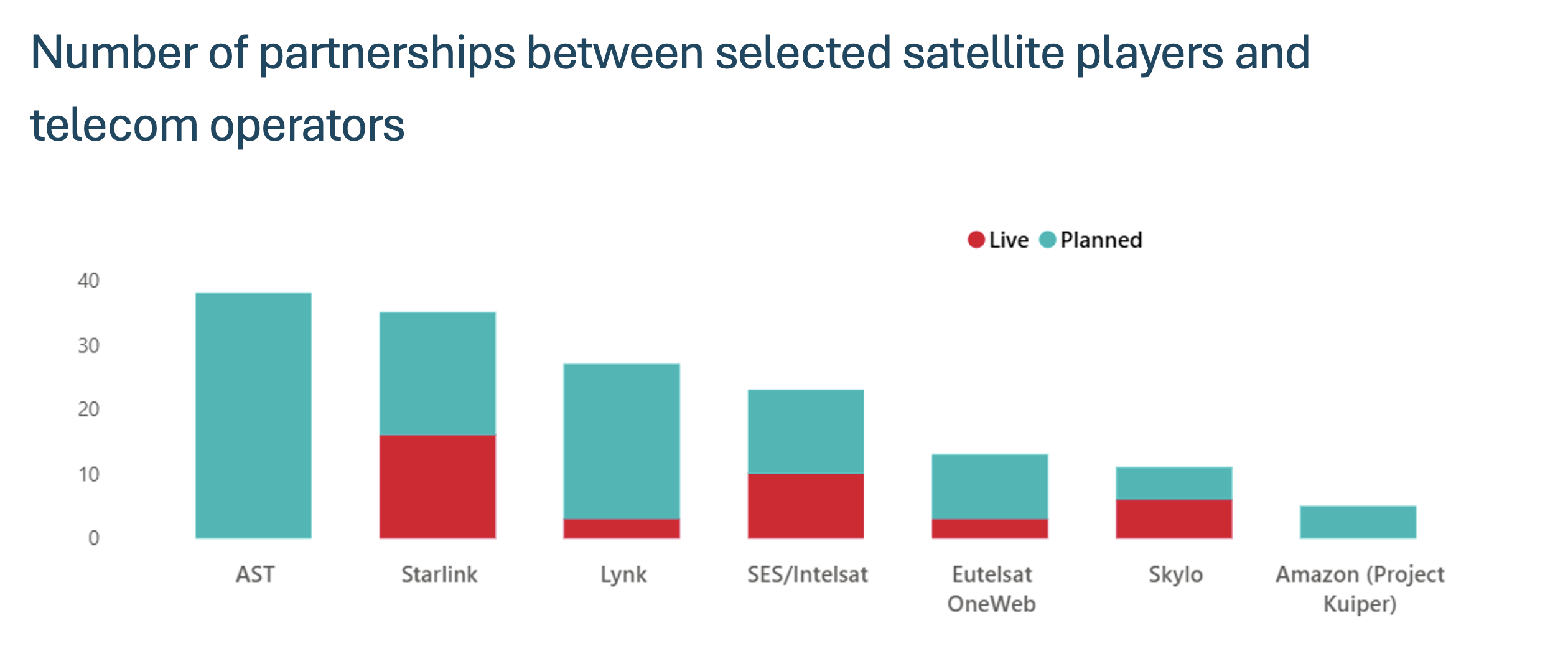
Source: GSMA Intelligence telco-satellite tracker
Being engaged means telecom operators themselves are publicly showcasing satellite-enabled connectivity as part of their customer experience strategy. They are counting satellite messages on their networks as an indicator of their satellite coverage. In April’25, One New Zealand reported 7 million satellite messages sent and 700,000 customers reached in its first year of service and published those numbers proudly. In July’25, KDDI also proudly announced that "au Starlink Direct" surpassed one million users while Rogers' Canada CEO cited 1 million satellite text messages by their trial customers during the commercial launch statement.
Being engaged means that through these partnerships, satellite players already have visibility into telecom operating models, distribution ecosystems and customer usage behaviour.
It also means that three companies that compete on everything from price, network quality, customer service, spectrum, are willing to come together in a joint venture to collectively manage the dependencies, risks and shifting leverage emerging from the satellite ecosystem.
And most importantly, it means that neither side can easily walk away anymore. Telecom operators need satellite coverage for ubiquitous connectivity, while satellite providers need operator distribution, spectrum access and customer reach to scale commercially.
So, the dilemma, ultimately, for both sides is not whether to engage or not – this way or that way. They are ALREADY ENGAGED!
The only question left is what that engagement model eventually looks like. The real battle now is over who gets to define the terms of that engagement. And the JV is the opening move. Whether it is also the decisive one depends on a judge in Washington, a rocket in Texas, and perhaps some enthusiastic IPO investors.
Author

- 200 reports a year
- 50 million data points
- Over 350 metrics
How can we support you?
Get in touch
Contact the GSMA Intelligence support team for help with your account, subscriptions, or access to reports and insights.
Newsletter
Subscribe to the GSMA Intelligence newsletter for the latest industry news and insights, delivered to your inbox.