
Nokia and Ericsson: Private 5G faces a reality check. Not a retreat
Recent Nokia and Ericsson announcements – what happened?
Between 2018 and 2025, Nokia expanded its enterprise private-network portfolio with Enterprise Campus Edge (including NDAC, MXIE, MX Connect and MX Workmate applications), while making Enterprise its second strategic customer segment after telecom operators in 2021. However, its 2025 AI-focused strategy, announced at the Capital Markets Day 2025, deprioritised Enterprise Campus Edge, culminating in the October 2026 agreement to sell the unit to Aurelius, with closing expected in H1 2027. However, this didn’t include the totality of what is Nokia’s enterprise wireless solution, as majority of it, the so-called mission critical private networks business, remains under Nokia.
In September 2024, Ericsson established Enterprise Wireless Solutions (BEWS) as a key pillar of its enterprise strategy, bringing together Wireless WAN Cradlepoint-originated portfolio of devices and private 5G. However, in October 2026, Ericsson announced that BEWS would “be moved to the parts of Ericsson best positioned to scale each activity, capture synergies and to better leverage R&D capabilities,” with private 5G moving into Business Area Networks, while Wireless WAN and Aduna remain standalone businesses. Unlike Nokia, Ericsson has not announced the divestment from any of those businesses.
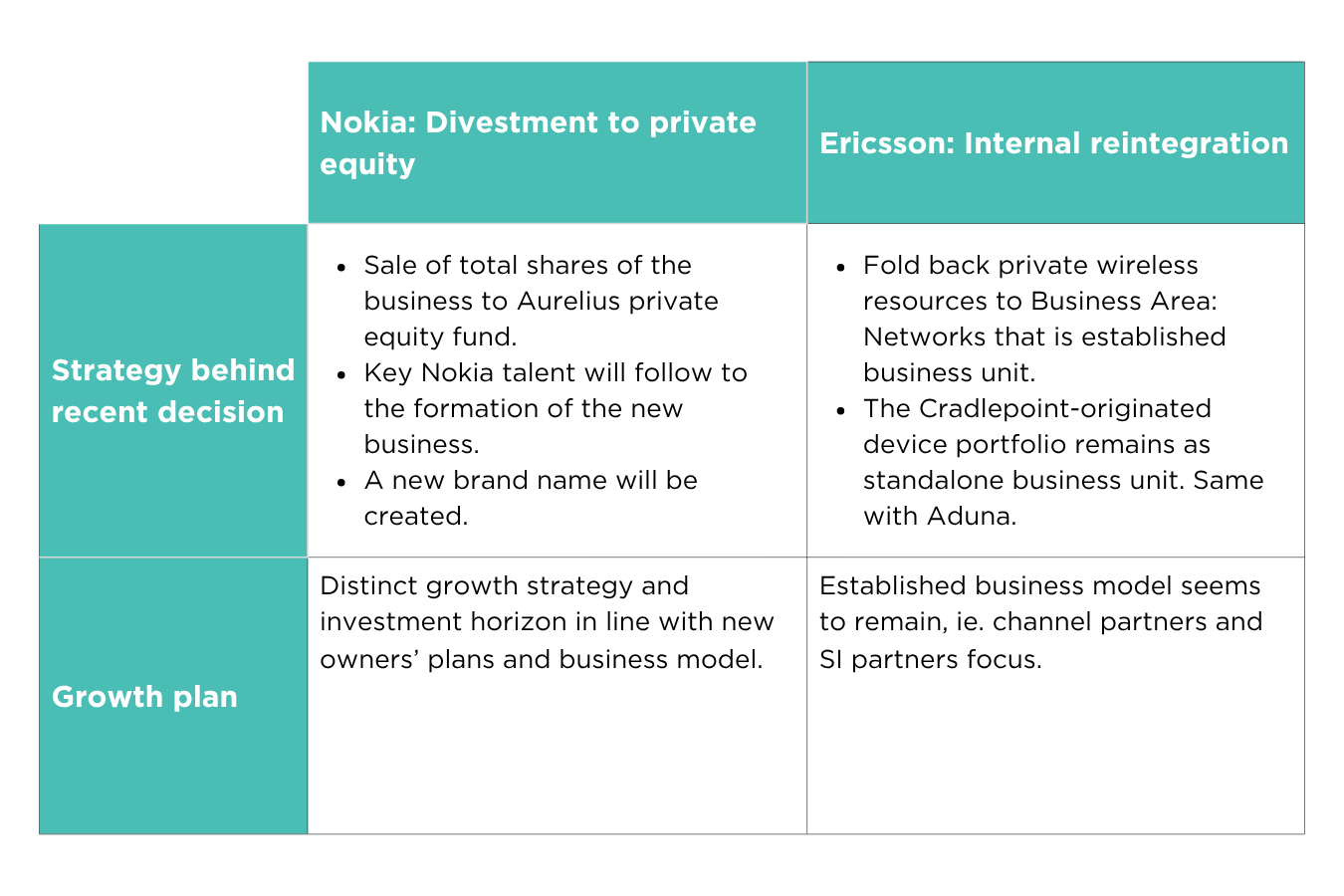
Two conclusions stand out. First, neither vendor is walking away from the enterprise opportunity. Second, neither vendor is walking away from private networks altogether, based on what’s announced until today. Ericsson is moving its private networks resources inside a larger, more established business unit, and likely signals that the broader Enterprise portfolio may be re-aligned at next stage. For Nokia, it is only selected elements of private networks that are being divested from. The question, then, is what is driving these decisions.
The undisputed achievements
Ericsson has increased private networks revenue by about 3x between 2020 and today, based on Ericsson execs commentary. While the company does not officially report the financial performance of its private networks portfolio, it has secured multiple operator and industrial customer agreements in recent years.
At the time of the divestment announcement, Nokia Enterprise Campus Edge had been adopted by 900 customers and was generating 170 million EUR revenue annually. This is in addition to Nokia’s “mission-critical private wireless” business, which remains under Nokia’s ownership, and generated about 1.4 billion EUR in FY2024.
The worrying signs & the likely thinking behind recent decisions
On the flip side, both vendors’ affected private networks* segments were likely loss-making. While tolerating losses for certain periods can be justified if the company is aiming to capture larger share in fast growing markets, for large public companies like Nokia and Ericsson, prioritising fiscal discipline and commercial focus on more profitable segments ultimately matter.
Does Nokia’s divestment sacrifice future growth and diversification? The sold business to Aurelius constitutes only a small part of Nokia’s private wireless business. Aurelius’ October 2026 press release revealed that the size of the business Nokia sold to them equals 170 million EUR, while according to Nokia’s reporting, the size of the so-called mission-critical private networks business that Nokia kept was around 1.4 billion EUR in FY2025. Projecting through to 2031, the Enterprise contribution to Nokia’s total revenues remains essentially unchanged whether or not the business sold to Aurelius is included**. The transaction therefore has little impact on Nokia’s projected revenue mix, despite transferring ownership of a faster-growing business.
Ericsson’s decision appears reasonable at first sight. Ericsson provides limited visibility into the revenue and profitability of private 5G, including the performance of its different sales channels. However, it is reasonable to assume the business was loss-making or operating on thin margins, strengthening the case for closer integration with Ericsson’s established R&D and product functions to capture synergies and efficiencies. Noting that this assessment is based only on publicly available information and may not reflect the full picture.
Implications for the market
Nokia’s and Ericsson’s decisions do not fundamentally alter the private networks market. Both will remain competitors in mission-critical private 5G, while Ericsson will also compete with Nokia’s divested Enterprise Campus Edge business in the more competitive non-mission-critical segment.
One consequence, however, could be reduced visibility and ability to track the market’s development. With Ericsson integrating private 5G more closely into its broader Networks business, reporting on the segment could become less granular. Similarly, under private-equity ownership, Nokia’s Enterprise Campus Edge business may not maintain the same level of external disclosure and analyst engagement previously provided by Nokia.
Implications for the two vendors and the new business
As Aurelius is reportedly doing with Nokia, Ericsson should incentivise talent retention while removing operational friction. Efficiencies can come from reducing R&D duplication, simplifying procurement and leveraging existing operator sales channels. Profitability will also depend on shorter sales cycles, smoother onboarding and stronger account management across enterprises and telecom operators.
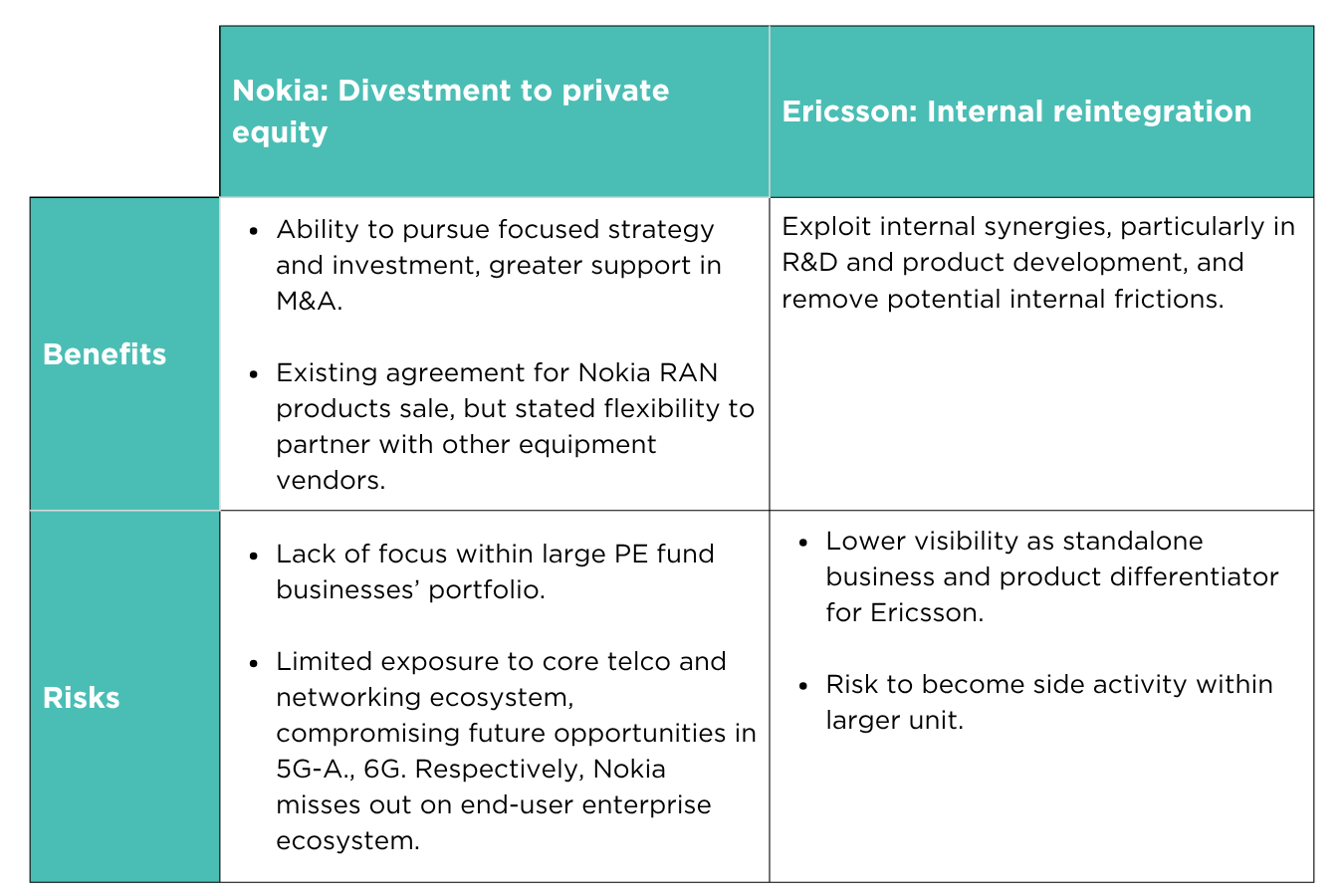
For Nokia, the divestment gives Enterprise Campus Edge dedicated ownership and potentially greater autonomy, but shifts control to a diversified private-equity investor. However, with no investment commitments disclosed so far, the new owner’s ambitions for the business remain unclear. The new business will need to balance long-term growth with the returns and eventual exit expected from private-equity ownership.
Overall, these developments signal a new phase rather than a retreat from private networks. Vendors now have years of experience to draw on, with the focus shifting towards more mature products, leaner operating models and more sustainable business models. The market continues, but its shape is evolving, and we will be keeping a close eye on where it goes next.
GSMA Intelligence publishes a regular update on the private network market, see the latest issue here Industry Checkpoint: private networks, Q3 2026 as well as telecoms operator case studies on the same topic.
*For Nokia, this refers to the Enterprise Campus Edge portfolio sold to Aurelius, as its mission-critical private networks part has been profitable and kept under Nokia’s ownership.
**based on internal calculations and GSMA Intelligence data
How can we support you?
Get in touch
Contact the GSMA Intelligence support team for help with your account, subscriptions, or access to reports and insights.
Newsletter
Subscribe to the GSMA Intelligence newsletter for the latest industry news and insights, delivered to your inbox.

- 200 reports a year
- 50 million data points
- Over 350 metrics
How can we support you?
Get in touch
Contact the GSMA Intelligence support team for help with your account, subscriptions, or access to reports and insights.
Newsletter
Subscribe to the GSMA Intelligence newsletter for the latest industry news and insights, delivered to your inbox.