
Mavenir Global Analyst Event 2026

Author
Mavenir's Global Analyst Event in October covered a wide range of developments. My colleague Shiv Putcha explores Mavenir's wider strategic direction in his forthcoming article, Mavenir resets for the AI Era. Here we take a closer look at one of those opportunities: using AI to create new value from traditional mobile voice services.
Can AI make mobile voice valuable again?
Mobile voice has become something of an afterthought in the telecoms industry. It remains an essential part of the mobile proposition, but operators have spent much of the past two decades competing on data allowances, network coverage and speed. Voice, meanwhile, has become a bundled service, with limited scope for differentiation or additional revenue.
That makes some of the developments in AI particularly interesting. At Mavenir's Global Analyst Event in October, much of the discussion focused on familiar industry priorities, including AI-native networks, automation, 6G and non-terrestrial connectivity. However, one of the more interesting opportunities was the application of AI to a service that has been around for decades: the traditional telephone call.
Real-time translation, AI-powered fraud detection, improved audio quality and intelligent assistants are among the capabilities being developed. None is entirely new in isolation, but integrating them into mobile networks could change what operators can offer through an ordinary voice call.
This raises two questions.
- Can AI make voice more useful to customers, and…
- Can operators turn that additional functionality into a meaningful commercial opportunity?
Adding intelligence to the conversation
Historically, improvements in mobile voice have largely concerned the quality and reliability of the connection. The transition to VoLTE and, more recently, VoNR has improved the underlying experience, but the functionality of a conventional call has changed relatively little.
The introduction of AI brings something different.
Real-time language translation is perhaps the most obvious example. Two people speaking different languages could hold a conversation over the mobile network without either needing a translation application. AI can also improve speech clarity by removing background noise, adjusting audio and compensating for problems caused by packet loss. Other capabilities extend beyond the conversation itself. AI assistants could take notes, produce summaries, arrange appointments or help callers complete tasks. For businesses, automated receptionists could handle routine enquiries and bookings when staff are unavailable.
Mavenir's AI Voice Agent (AVA) platform is designed to bring these capabilities into the operator's voice network. The platform supports services including translation, transcription, voice enhancement and fraud detection, while allowing operators to use different AI models according to the application. Mavenir has also partnered with Sanas to incorporate real-time speech AI into its broader MAVcore Voice AI portfolio.
The significance is not simply that these services exist, but that they could become available through conventional calling. Rather than depending on both participants having a particular application or handset, the intelligence can be introduced within the operator's network.
For operators, this offers the prospect of adding value to an established service without having to persuade customers to adopt an entirely new way of communicating.
From demonstration to deployment
At the event, Turkcell demonstrated how their real-time Turkish-to-English translation works over the Mavenir core. The service uses AI capabilities integrated into the voice network, allowing translation without a separate application. The project illustrates how operators can introduce new functionality using existing communications infrastructure.
However, there is an important distinction between demonstrating a service and establishing a commercial market for it. A successful translation demonstration does not tell us how many subscribers will use the capability regularly, whether they will pay for it or what the service will cost to provide at scale.
Moving from demonstration to commercial deployment presents several challenges:
- Accuracy and latency: Real-time translation must preserve the meaning of a conversation without introducing delays that disrupt its natural flow.
- Consistency: Services need to perform reliably across different languages, accents and network conditions.
- Reliability: AI assistants must be able to complete tasks accurately, particularly when handling bookings, payments or other actions on behalf of customers.
- Network integration: Unlike standalone applications, network-based AI services must operate alongside existing subscriber controls, signalling, billing and regulatory requirements.
- Privacy and consent: Operators must ensure that customers understand and consent to how their conversations are analysed, processed or transformed.
Mavenir's approach is to incorporate these functions into AVA, rather than leaving operators to integrate each AI application separately. Its architecture is intended to work with both Mavenir and third-party IMS deployments, with a common service layer managing activation, authorisation and the underlying AI models.
The approach makes sense from an operator perspective. The ability to add new capabilities without repeatedly changing the core voice infrastructure could reduce the complexity of introducing services. Whether this translates into faster commercial adoption will depend on how well those capabilities perform outside controlled demonstrations.
Not every AI voice service has the same commercial potential
Although the range of applications is growing, their value to customers is likely to vary considerably.
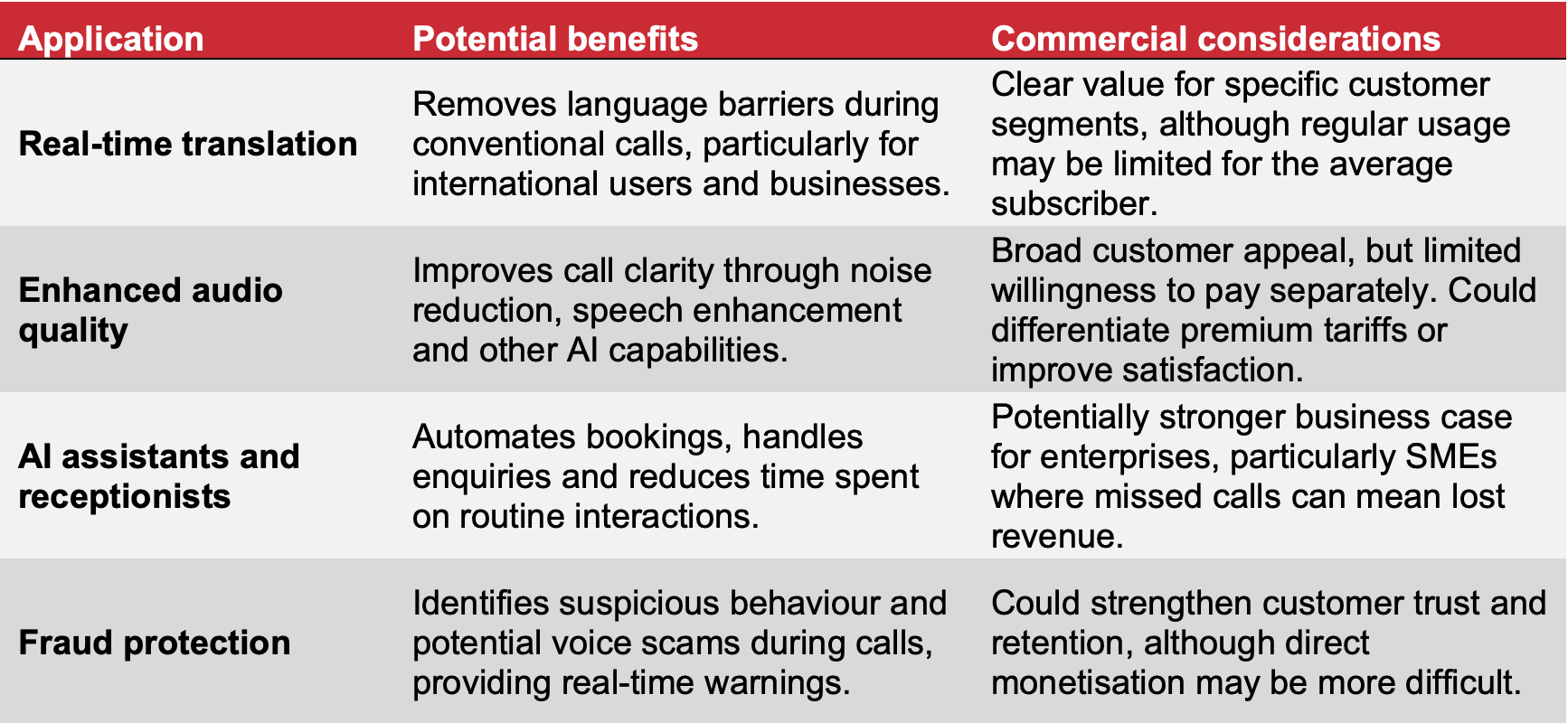
This suggests that operators should be selective rather than trying to commercialise every available capability. Some applications could generate direct revenue, while others may be better suited to improving the overall customer proposition.
The economics of AI voice need careful consideration
Monetisation was a recurring theme throughout Mavenir's event, extending beyond voice to the wider challenge of turning AI infrastructure and applications into sustainable revenue.
Voice introduces an interesting complication. Consumers have become accustomed to unlimited calling being included within their mobile tariffs. Charging extra for intelligence added to those calls requires operators to demonstrate a benefit that customers recognise and value.
There is also the cost of delivering the service. Traditional voice economics are relatively predictable, particularly within an established network. AI processing is different. Costs can vary according to the duration of a call, the models used, the complexity of the task and where the processing takes place. A service that involves continuous translation may have a very different cost profile from one that produces a short summary after a call.
Heavy users could therefore account for a disproportionate share of the costs, making a simple unlimited subscription less attractive to operators. Usage-based pricing could address this but introduces its own complications for customers who are accustomed to making calls without thinking about the minutes consumed.
This is why the supporting commercial infrastructure matters. Mavenir's AI monetisation presentations highlighted the need for new approaches to metering, charging and billing, including the ability to account for different AI models and processing costs. The challenge is not just to introduce a new service, but to ensure that its underlying economics remain manageable as usage grows.
Different applications will probably require different commercial models. Translation may lend itself to usage-based charging or targeted premium packages. Enterprise assistants could be priced around subscriptions or the tasks they complete. Meanwhile, improved voice quality and fraud protection may provide greater value through customer retention than through direct charges.
For now, operators will need to test demand and willingness to pay rather than assume that the availability of new functionality will generate additional revenue.
Will AI actually encourage people to make more calls?
Beyond monetisation, there is a more fundamental question about what these developments could mean for voice usage. The shift towards messaging and other digital communications has changed consumer behaviour. For many interactions, sending a message is quicker and more convenient than making a call, and the addition of AI is unlikely to reverse this preference.
However, AI could make voice more attractive in situations where a conversation offers clear advantages. Translation could enable calls that would otherwise be difficult. Better fraud protection might encourage people to answer unfamiliar numbers, while intelligent assistants could make it easier to complete tasks that currently involve several separate interactions.
The impact may be particularly noticeable in business communications, where improving the outcome of a call can be more valuable than simply increasing the number of calls made.
There is also a possible contradiction. As AI assistants become more capable, some services may actually reduce the need for direct conversations between people. An automated receptionist that successfully handles a booking has created value but may have replaced a call that would previously have required human involvement.
Consequently, the success of AI voice should not necessarily be judged by whether traditional call volumes start to increase. Operators may be able to generate more value from voice services even if the number of human-to-human conversations continues to decline.
Can AI deliver a new chapter for voice?
For years, operators have focused much of their innovation and investment on data services, while voice has become standardised. AI offers an opportunity to reconsider that position, introducing functionality that could make an established service more useful and, in some cases, more valuable.
The developments presented by Mavenir, including AVA and its collaboration with Sanas, show how these capabilities could be incorporated into existing mobile networks. Turkcell's work on live translation provides an early example of the approach moving beyond the laboratory.
Technical performance, customer experience, regulatory requirements and processing costs will all influence which services reach the market and how widely they are adopted. The most likely outcome is not a wholesale revival of traditional voice calling, but a broader range of services built around it. Some may generate additional revenue directly, while others will strengthen the value of the existing mobile proposition.
For operators, the opportunity is worth investigating. Whether AI can make voice an important source of growth again will depend less on how many new features can be demonstrated and more on those which customers find useful enough to pay for.
How can we support you?
Get in touch
Contact the GSMA Intelligence support team for help with your account, subscriptions, or access to reports and insights.
Newsletter
Subscribe to the GSMA Intelligence newsletter for the latest industry news and insights, delivered to your inbox.

- 200 reports a year
- 50 million data points
- Over 350 metrics
How can we support you?
Get in touch
Contact the GSMA Intelligence support team for help with your account, subscriptions, or access to reports and insights.
Newsletter
Subscribe to the GSMA Intelligence newsletter for the latest industry news and insights, delivered to your inbox.