
How are MNOs cutting greenhouse gas emissions beyond network efficiency and renewable energy?
Author
Achieving net-zero emissions by 2050 remains one of the telecom industry's biggest challenges. Most mobile network operators (MNOs) are pursuing this goal through traditional measures such as improving network energy efficiency and increasing the use of renewable energy. However, these efforts alone may not be sufficient to close the remaining emissions gap. As a result, operators are increasingly exploring a broader range of initiatives that extend beyond conventional network decarbonization, from ecosystem restoration and community clean-energy programs to circular infrastructure, smarter energy management and new procurement approaches.
Not all emissions sit within an operator's direct control, as a significant share of emissions come from outside the operations. Operators can only reduce their emissions to a certain level, beyond which it looks for ways to offset emissions through carbon-removal and ecosystem-restoration projects, to address their remaining environmental impact.
Since 2020, the top 10 MNOs globally1 (by subscriber base) have introduced or supported over 500 unconventional sustainability initiatives, either independently or through partnerships.
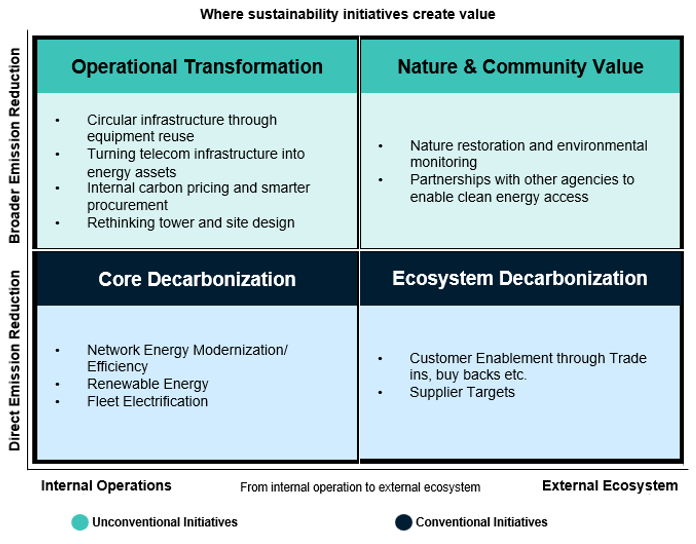
These unconventional initiatives can be grouped into six major themes:
1. Circular infrastructure through equipment reuse
As MNOs continue to modernize their networks, extending the lifespan of equipment is becoming an important sustainability lever. Rather than following a linear "buy, use and replace" model, operators are increasingly adopting reuse and refurbishment practices. Telefónica's MAIA platform and Orange's OSCAR program are examples of this approach, helping reduce waste, lower capital requirements and mitigate supply-chain risks. This reflects a shift towards extending asset life while reducing resource consumption across network operations.
2. Turning telecom infrastructure into energy assets
Network infrastructure is increasingly being viewed as more than just a consumer of energy. Operators are exploring ways to use existing assets more efficiently and support wider energy systems. Examples include Elisa's virtual power plant model, to use backup batteries from base stations for grid balancing, and Deutsche Telekom's use of waste heat from network facilities.
3. Internal carbon pricing and smarter procurement
Sustainability is also becoming part of how operators evaluate investments and procurement decisions. Telefónica has incorporated internal carbon pricing into procurement processes, ensuring that factors such as energy consumption, emissions and lifetime operating costs are considered alongside purchase price. This integrates carbon considerations into investment and procurement decisions alongside cost and performance.
4. Rethinking tower and site design
Reducing emissions is not only about cleaner energy sources; site design also plays an important role. Operators are increasingly focusing on more efficient, resilient and lower-maintenance infrastructure. Airtel Africa's lean sites in Nigeria and NTT DOCOMO's self-powered hydropower base station illustrate how site design can reduce operational requirements while supporting sustainability goals.
5. Nature restoration and environmental monitoring
Nature restoration is emerging as another area of focus for telecom operators. Projects involving forests, mangroves and coral reefs can support biodiversity while contributing to long-term carbon sequestration. Operators are increasingly applying their connectivity and data capabilities to improve environmental monitoring. Orange Business and Tēnaka's coral reef monitoring project, alongside Vodafone's environmental monitoring initiative in Scotland are some of the examples.
6. Partnerships with other agencies
Some operators are supporting clean-energy adoption within local communities. For instance, Safaricom's partnership with Sistema.bio in Kenya is helping farmers access biodigesters through mobile-enabled payment and loyalty mechanisms. This way, MNOs are leveraging their customer reach and digital platforms to support clean-energy adoption.
It’s more than an operator story
The shift towards unconventional sustainability initiatives has implications that extend well beyond the operators themselves.
- Network equipment and Vendors: As equipment suppliers are increasingly being drawn into circular economy commitments as a condition of doing business with operators. Orange's OSCAR program, for instance, established a formal refurbishment partnership with Nokia.
- Regulators: As operators repurpose network infrastructure as energy assets, regulatory frameworks are being tested beyond their original scope. Elisa's participation in Finland's electricity balancing markets required formal technical pre-qualification from Fingrid, a process with no precedent in the telecoms sector. Regulatory support for distributed energy participation is beginning to emerge globally. The EU Electricity Market Reform (Directive EU 2024/1711), the United States' FERC Order 2222 and Australia's new virtual power plant market reforms all create pathways for distributed energy resources to participate in electricity markets. However, these frameworks were not designed with mobile operators in mind, and telecom-specific regulatory pathways remain largely absent. As operators seek to monetize base-station batteries and other distributed assets, energy regulators will need to develop frameworks that explicitly recognize MNOs as potential market participants.
Looking ahead
As per our Mobile Net Zero report, the mobile industry's operational emissions fell by 8% between 2019 and 2023, even as data traffic quadrupled. However, the industry must reduce emissions by 7.5% annually by 2030 (which is more than twice the average annual rate achieved to date) to reach net zero by 2050. These initiatives address this gap by expanding climate action beyond traditional network-focused measures.
The initiatives documented here follow a common characteristic: they build on MNOs’ existing strengths: distribution reach, connectivity infrastructure, digital platforms and customer relationships.
None of these initiatives replace the need for network modernization or renewable energy. Rather, they complement traditional decarbonization strategies. Taken together, they suggest that telecom sustainability is becoming broader in scope. As the industry progresses towards its net-zero goals, unconventional initiatives are likely to play an increasingly important supporting role alongside core network-focused emissions reduction efforts.
The GNI project, is entering its third year, is free, and is looking forward to welcoming new network operators to join at no cost.
1. Based on the mobile subscribers, the top 10 MNOs as of August 2026 are China Mobile, Reliance Jio, China Telecom, Airtel (Bharti Airtel), China Unicom, Vi, Telkomsel (Telkom Indonesia), Verizon Wireless, T-Mobile (Deutsche Telekom), AT&T.
How can we support you?
Get in touch
Contact the GSMA Intelligence support team for help with your account, subscriptions, or access to reports and insights.
Newsletter
Subscribe to the GSMA Intelligence newsletter for the latest industry news and insights, delivered to your inbox.

- 200 reports a year
- 50 million data points
- Over 350 metrics
How can we support you?
Get in touch
Contact the GSMA Intelligence support team for help with your account, subscriptions, or access to reports and insights.
Newsletter
Subscribe to the GSMA Intelligence newsletter for the latest industry news and insights, delivered to your inbox.