
6G from launch to scale: 2.4 billion connections by 2035

Author
GSMA Intelligence has launched its latest mobile technology forecasts, extending our outlook to 2035 and, for the first time, providing a detailed view of the expected transition to 6G.
The new forecasts, now available on the GSMA Intelligence data platform, track the evolution of mobile connections across 2G, 3G, 4G, 5G and 6G by country and operator. They provide a first look at where 6G adoption is likely to happen earliest, which markets will provide the greatest scale and how the next generation will coexist with 5G through the first half of the 2030s.
From launch to global scale
The ITU established IMT-2030 as the framework for 6G in 2023. Work has since progressed, with draft technical performance requirements agreed in February 2026. These requirements cover six usage scenarios, spanning the evolution of established mobile capabilities as well as newer areas such as ubiquitous connectivity, AI and communications, and integrated sensing and communications (ISAC).
At the end of 2030, GSMA Intelligence forecasts approximately 50 million 6G connections globally, representing only around 0.5% of the mobile connections base. Adoption increases steadily thereafter, reaching around 275 million connections at the end of 2031 and nearly 740 million in 2032. During 2033, 6G crosses the one billion mark, ending the year at approximately 1.3 billion connections, before reaching 1.9 billion in 2034 and 2.4 billion in 2035.
Source: GSMA Intelligence
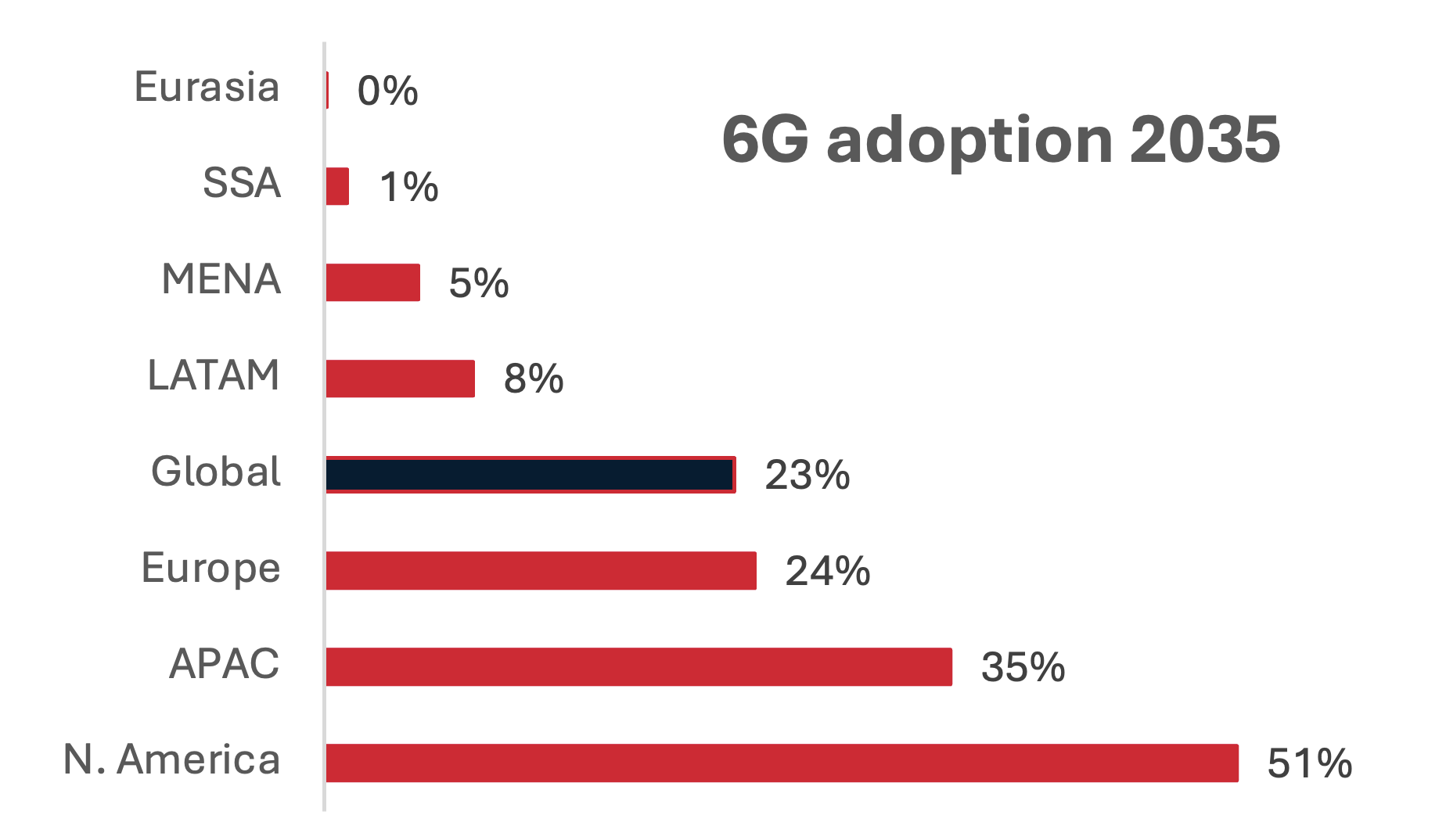
The forecast therefore points to two distinct phases in the first 6G cycle. The period from 2030 to 2032 is primarily characterised by initial launches and ecosystem development, while from 2033 onwards 6G begins to operate at global scale. Importantly, this expansion does not come at the expense of 5G. By the end of 2035, 5G is still forecast to account for around 60% of global mobile connections, compared with 23% for 6G and 17% for 4G.
The first half of the 2030s will consequently be characterised by technology coexistence rather than universal replacement. Operators will spend the remainder of the 2020s expanding 5G coverage, deploying 5G Standalone and introducing 5G-Advanced capabilities, with 6G building on many of the architectural and technological changes already taking place across mobile networks.
Early adoption will be concentrated
As with previous technology generations, the transition to 6G will not happen everywhere at the same speed. The first wave is expected to be concentrated in advanced mobile markets across East Asia, North America and parts of Europe, where high levels of 5G adoption, established device ecosystems and demand for network capacity provide the foundations for an earlier transition.
China will inevitably have a significant influence on the global numbers because of the scale of its mobile market, with more than half of connections forecast to use 6G by 2035. It will not, however, be unique in reaching this level of adoption, with several of the world's leading mobile markets forecast to have around half of connections on 6G by the middle of the next decade. Large emerging markets will also make a significant contribution to the global total: even at lower adoption rates, the scale of their existing mobile bases means technology migration can translate into substantial numbers of connections.
The contrast becomes clearer at regional level. By the end of 2035, around half of connections in North America are forecast to use 6G, while East Asia is similarly at the forefront of the transition. Europe follows, with approximately one-quarter of connections expected to have migrated to 6G.
Elsewhere, adoption is forecast to remain below 10% across several emerging-market regions by the end of the forecast period. These differences largely reflect the position of individual markets within their existing technology cycles. Many emerging markets will still be completing the transition from 4G to 5G during the early 2030s, making further 5G coverage expansion and adoption a more immediate priority than another nationwide technology migration.
More traffic, and a changing traffic mix
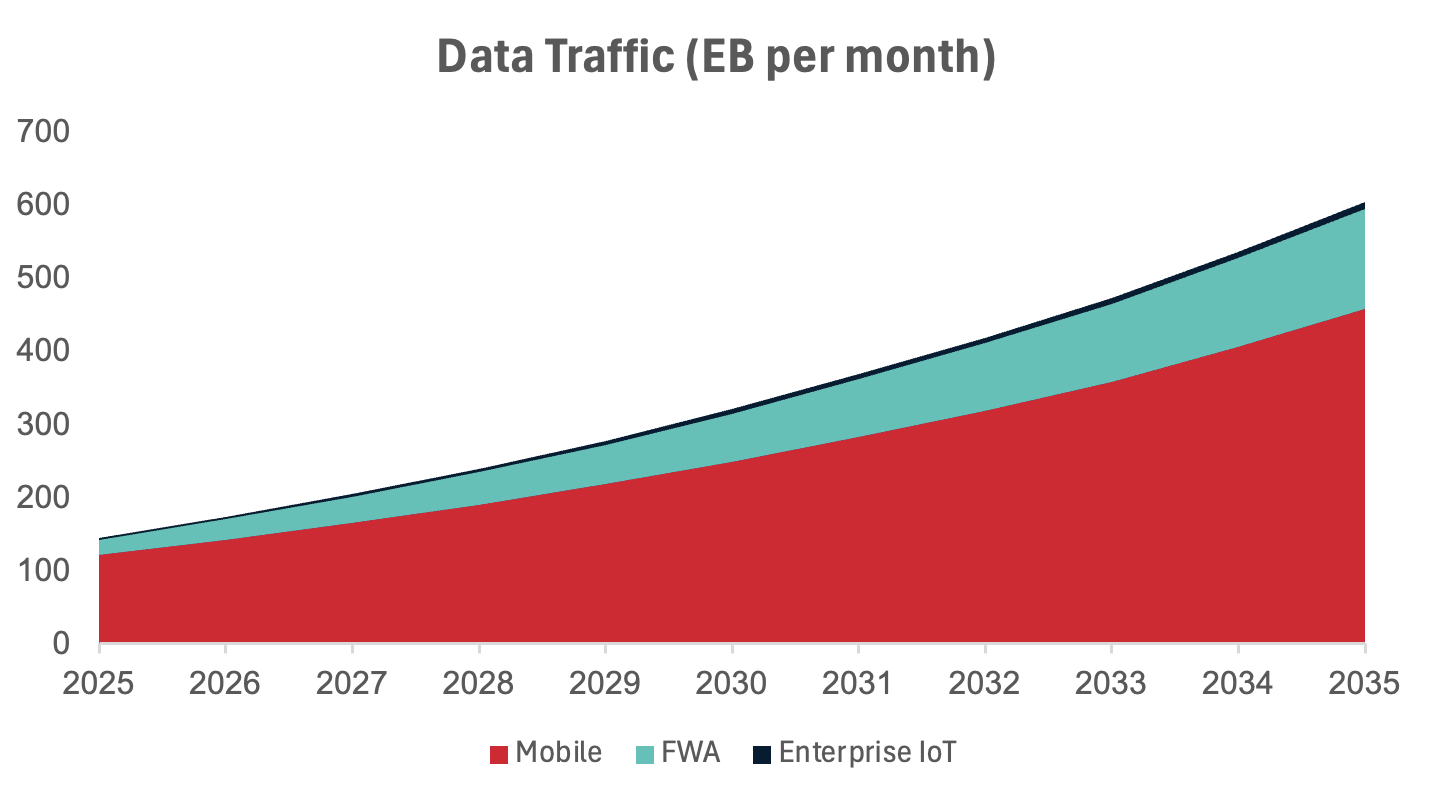
Capacity will remain an important driver of network evolution. GSMA Intelligence forecasts total mobile network traffic will increase more than fourfold over the next decade, from around 144 EB per month in 2025 to 604 EB per month in 2035.
Source: GSMA Intelligence
The type of traffic will evolve: video will remain the largest source, but emerging categories will become more significant. Our forecasts show particularly strong growth from AI , extended reality (XR) and, from a network perspective, 5G fixed wireless access. At the same time, AI-enabled devices, cameras, sensors and XR applications could change the nature of network demand as devices increasingly create and transmit content as well as consume it, placing different requirements on uplink capacity, latency and reliability.
Our central forecast implies annual traffic growth of around 15% over the next decade. This would leave networks carrying more than four times today's traffic by 2035. Meeting this demand will require a combination of greater network efficiency, additional capacity and spectrum.
In terms of the amount of spectrum, the GSMA's Vision 2040 analysis estimates that 2–2.5 GHz of mid-band spectrum could be required between 2035 and 2040 to meet demand in high-population-density locations, increasing to 2.4–3.3 GHz in countries with higher demand. This compares with around 1 GHz of mid-band spectrum currently identified for mobile in most countries. The analysis therefore points to an additional mid-band requirement of 1–2 GHz, alongside continued improvements in spectral efficiency and network densification.
Managing continued growth in data traffic will remain a fundamental requirement for mobile networks, but the rationale for 6G extends beyond capacity alone. The next generation is being designed around a broader set of capabilities that could change not only how much data networks carry, but also the functions they perform.
From communications network to intelligent platform
The ITU's IMT-2030 framework provides a useful indication of how ambitions for the next mobile generation are evolving. Alongside improvements in conventional network performance, 6G introduces capabilities and usage scenarios covering AI integration, sensing and broader connectivity, with greater levels of sustainability, security and resilience, connecting the unconnected and ubiquitous intelligence among the overarching design principles.
AI is likely to influence the development of 6G in two ways. Networks will need to support a growing number of AI-enabled applications and devices, while AI is also expected to become more deeply embedded within network operations. This could enable greater automation of functions such as resource allocation, network optimisation and energy management. The Next G Alliance similarly identifies AI-native networking as a central element of its 6G roadmap, with the aim of improving network robustness, performance and efficiency as traffic types, deployment topologies and spectrum environments become more complex.
Integrated sensing and communications (ISAC) represents another potentially significant change. Traditionally, mobile networks have been designed primarily to communicate with connected devices. With ISAC, radio signals could also be used to detect and interpret aspects of the physical environment, including location, movement and objects. Potential applications span areas such as infrastructure monitoring, industrial systems and autonomous applications. ISAC is one of the ITU's six IMT-2030 usage scenarios and has become an active area of pre-standardisation work, with the Next G Alliance examining use cases, deployment scenarios, spectrum requirements and technical challenges.
More broadly, 6G encompasses greater integration between communications and computing, new spectrum and radio technologies, connectivity across a wider range of devices and environments, and higher levels of network automation. Its eventual value proposition may therefore extend well beyond another improvement in smartphone download speeds. For the industry, the more important question will be whether these capabilities can translate into new services, greater network efficiency and commercially sustainable use cases that are difficult to deliver with existing networks.
2035 is a milestone, not the end point
The 2.4 billion connections forecast for 2035 should not be interpreted as representing a mature 6G market. More than three-quarters of the world's mobile connections will still be using an earlier technology, leaving considerable scope for migration beyond the end of the forecast period.
The industry has spent much of the current decade taking 5G from launch to global scale, while the foundations of the next transition are already taking shape through standardisation, spectrum planning, research and technology development. By 2035, 6G will have moved firmly into the global mobile technology mix, but it will coexist with a much larger 5G base and with 4G still playing an important role in many markets.
This coexistence is likely to be one of the defining characteristics of the early 6G era. The transition will begin first in markets where the technology, spectrum and commercial conditions support it, while elsewhere operators will continue to extract value from 5G and, in some cases, 4G. The result will not be a single global transition point, but a further diversification of the technology mix as the next generation moves from initial deployment towards wider adoption.
The new GSMA Intelligence mobile technology forecasts to 2035, including detailed 6G forecasts by market and operator, are now available on the GSMA Intelligence data platform.
How can we support you?
Get in touch
Contact the GSMA Intelligence support team for help with your account, subscriptions, or access to reports and insights.
Newsletter
Subscribe to the GSMA Intelligence newsletter for the latest industry news and insights, delivered to your inbox.

- 200 reports a year
- 50 million data points
- Over 350 metrics
How can we support you?
Get in touch
Contact the GSMA Intelligence support team for help with your account, subscriptions, or access to reports and insights.
Newsletter
Subscribe to the GSMA Intelligence newsletter for the latest industry news and insights, delivered to your inbox.