
US cable MVNOs edge along the path to profitability
Access this insight with a Premium plan. Contact our sales team to get started.
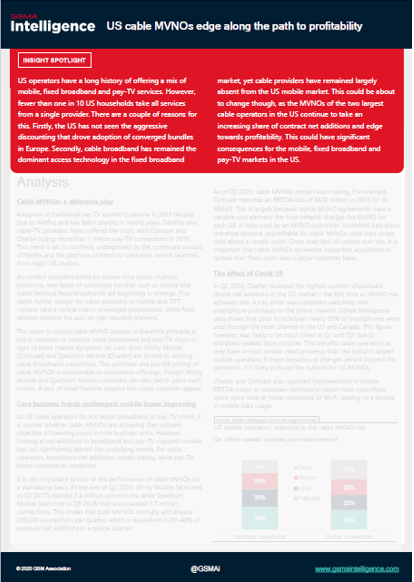
US operators have a long history of offering a mix of mobile, fixed broadband and pay-TV services. However, fewer than one in 10 US households take all services from a single provider. There are a couple of reasons for this. Firstly, the US has not seen the aggressive discounting that drove adoption of converged bundles in Europe. Secondly, cable broadband has remained the dominant access technology in the fixed broadband market, yet cable providers have remained largely absent from the US mobile market. This could be about to change though, as the MVNOs of the two largest cable operators in the US continue to take an increasing share of contract net additions and edge towards profitability. This could have significant consequences for the mobile, fixed broadband and pay-TV markets in the US.
Report details
US cable MVNOs edge along the path to profitability
Report details
US cable MVNOs edge along the path to profitability
Related research
Closing the Mobile Connectivity Gap in Developing Asia and the Pacific
Developing Asia Pacific is home to 4.3 billion people – more than half the world’s population. However, 1.2 billion people are not online. Achieving universal connectivity by 2030 will require additional investment of around $184 billion. The economic case for closing this gap is significant. Closing the 4G connectivity gap by 2030 is estimated to deliver a GDP uplift of around $230 billion across Developing Asia Pacific. Universal connectivity would also have several wider socioeconomic benefits such as poverty reduction, improved education and health access, humanitarian assistance and lower carbon emissions. This report presents the findings from a study by GSMA Intelligence on closing the mobile connectivity gap in Developing Asia Pacific, commissioned by the Asian Development Bank.
The Mobile Economy North America 2026
As 5G standalone and 5G-Advanced mature across North America, mobile connectivity is becoming strategic infrastructure for AI, cloud services, industrial automation and new enterprise applications. Continued investment in mobile networks will be critical to improve productivity, strengthen resilience and maintain the region’s long-term competitiveness. In 2025, mobile technologies and services generated $1.9 trillion in economic value across North America, equivalent to 5.8% of regional GDP.
Telcos and sovereignty: state of the market
Sovereignty has moved from being a strategy position on paper to actual deployment plans. Most operators are building selectively at the data and infrastructure layers, where they already have assets. As well as outlining why sovereignty matters now and presenting global and regional landscapes, this research examines telco approaches to sovereignty so far and the priorities ahead for both operators and governments.
Authors
How to access this report
Annual subscription: Subscribe to our research modules for comprehensive access to more than 200 reports per year.
Enquire about subscriptionContact our research team
Get in touch with us to find out more about our research topics and analysis.
Contact our research teamMedia
To cite our research, please see our citation policy in our Terms of Use, or contact our Media team for more information.
Learn more- 200 reports a year
- 50 million data points
- Over 350 metrics
How can we support you?
Get in touch
Contact the GSMA Intelligence support team for help with your account, subscriptions, or access to reports and insights.
Newsletter
Subscribe to the GSMA Intelligence newsletter for the latest industry news and insights, delivered to your inbox.