
Spectrum and Rural Connectivity
This insight is open to all subscribers and registered users, or available by completing the form.
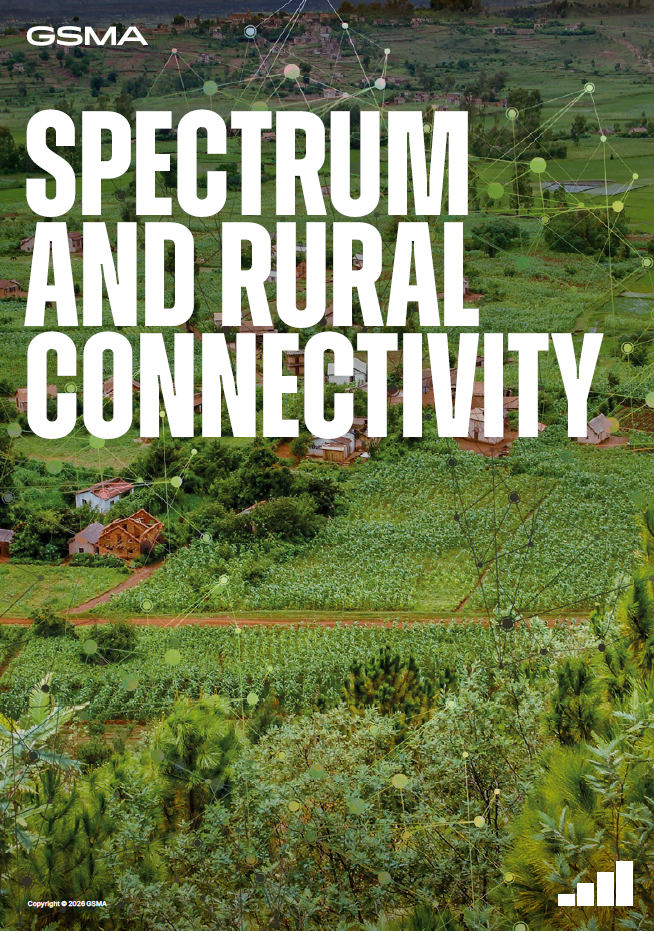
This latest research examines how the digital divide affects people living in rural areas, and how governments and regulators can address this challenge.
Although significant progress has been made extending network coverage, rural populations remain 28% less likely to use mobile internet than their urban counterparts, and 30% less likely to regularly engage in online services such as messaging, banking and education. Where connectivity is available, network quality - which relies on low bands in rural areas - remains a key barrier to greater use, limiting the ability of rural communities to fully participate in the digital economy.
This research highlights how increased amounts of low-band spectrum (below 1 GHz) can have a significant real-world impact. Each additional 50 MHz of low-band spectrum is associated with a 7 percentage-point increase in 4G coverage and an 11 percentage-point increase in 5G coverage in rural areas. Increased low-band spectrum availability is also linked to higher rural download speeds and reduced congestion at the cell edge, where rural users are most likely to experience connectivity issues.
Report details
Spectrum and Rural Connectivity
Download the report
Complete the form to get instant access to this content. For easier access in the future, you can register for a free account here.
By submitting this form, you agree that your email address and related activity on the platform will be processed for the purpose of generating and providing the requested report. Your data will be shared with GSMA Intelligence for this purpose. For more information, please see the GSMA Intelligence Privacy Policy.
Report details
Spectrum and Rural Connectivity
Download the report
Complete the form to get instant access to this content. For easier access in the future, you can register for a free account here.
By submitting this form, you agree that your email address and related activity on the platform will be processed for the purpose of generating and providing the requested report. Your data will be shared with GSMA Intelligence for this purpose. For more information, please see the GSMA Intelligence Privacy Policy.
Related research
Rural renewal: telcos and sustainable energy in Africa
The economics of rolling out telecoms networks in rural areas have long proved challenging. The difficulties centre on running a high fixed cost business against a lower revenue base. To examine the state and outlook for energy use among African telecoms operators, GSMA Intelligence ran a data gathering exercise involving most of the largest telecoms operators in the region.
The impact of spectrum pricing in Bangladesh
At around 16%, Bangladesh’s spectrum-cost-to-revenue ratio exceeds the Asia Pacific median (10.4%) and is twice as high as the global median (7.7%). High spectrum cost has been shown to negatively impact consumer outcomes, such as network coverage and speeds. Reducing prices by 50% would align spectrum costs closer to the Asia Pacific median at about 12% by 2035, boosting 4G speeds by 17% and enabling 99% 5G coverage, yielding a cumulative $34 billion GDP boost. Aligning costs to the global median of 8% of operators’ revenue would increase 4G speeds by 22% and accelerate 5G rollout further, generating a $45 billion GDP boost.
Spectrum Pricing in the 5G Era: Türkiye
As demand for mobile data accelerates, spectrum policy will play a decisive role in determining whether Türkiye can keep pace with international connectivity standards or fall behind.
Authors
How to access this report
Annual subscription: Subscribe to our research modules for comprehensive access to more than 200 reports per year.
Enquire about subscriptionContact our research team
Get in touch with us to find out more about our research topics and analysis.
Contact our research teamMedia
To cite our research, please see our citation policy in our Terms of Use, or contact our Media team for more information.
Learn more- 200 reports a year
- 50 million data points
- Over 350 metrics
How can we support you?
Get in touch
Contact the GSMA Intelligence support team for help with your account, subscriptions, or access to reports and insights.
Newsletter
Subscribe to the GSMA Intelligence newsletter for the latest industry news and insights, delivered to your inbox.