
Majority of developing world mobile markets have no plans for MNP - Asian and African regulators lukewarm on mobile number portability
This insight is open to all subscribers and registered users, or available by completing the form.
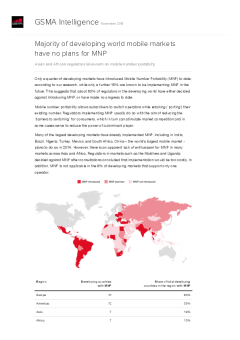
Only a quarter of developing markets1 have introduced Mobile Number Portability (MNP) to date, according to our research, while only a further 15% are known to be implementing MNP in the future. This suggests that about 60% of regulators in the developing world have either decided against introducing MNP, or have made no progress to date.
Mobile number portability allows subscribers to switch operators while retaining (‘porting’) their existing number. Regulators implementing MNP usually do so with the aim of reducing the ‘barriers to switching’ for consumers, which in turn can stimulate market competition and in some cases serve to reduce the power of a dominant player.
Many of the largest developing markets have already implemented MNP, including in India, Brazil, Nigeria, Turkey, Mexico and South Africa. China – the world’s largest mobile market - plans to do so in 2014. However, there is an apparent lack of enthusiasm for MNP in many markets across Asia and Africa. Regulators in markets such as the Maldives and Uganda decided against MNP after consultations concluded that implementation would be too costly. In addition, MNP is not applicable in the 8% of developing markets that support only one operator.

| Region |
Developing countries with MNP |
Share of total developing countries in the region with MNP |
|---|---|---|
| Europe | 12 | 80% |
| Americas | 12 | 35% |
| Asia | 7 | 19% |
| Africa | 7 | 13% |
| Total | 38 | 25% |
MNP status across developing economies
Source: GSMA Intelligence
1 GSMA Intelligence classifies developing countries and economies as defined by the World Bank
The impact of MNP in developing markets is linked to two factors: the time taken to port numbers and the fee charged to the subscriber to use the facility. The porting time after submission of request varies from as long as two weeks in some countries to just a few minutes in others. In Ghana, for example, 92% of porting requests are completed within 5 minutes. Almost half a million numbers (447,095) were ported in the country during the year ending June 2013, up 21% year-on-year.
By contrast, in Kenya, it is cheaper to buy a new SIM than to port from one operator to another. The Kenyan regulator attributes low uptake of the service to “the lowering tariff differentials between operators and the convenience brought about by dual SIM card mobile handsets.” According to the regulator, the number of inward ports in Kenya fell to just 1,256 in the year ending March 2013, down 89% on the previous year.
On a regional basis, MNP is most prevalent in Europe: only three developing markets in Europe have yet to introduce the service, and two of these (Russia and the Ukraine) plan to do so soon. This means that potentially 14 out of the 15 European developing countries will have introduced MNP by next year, with Kosovo the sole exception.
Seven developing countries in Asia have launched MNP to date. China has trialled MNP in Tianjin and Hainan ahead of next year’s full implementation, though take-up was weak: only 50,000 of a possible 15 million subscribers switched numbers.
A further seven countries have implemented MNP in Africa, including Nigeria, South Africa, Ghana and Kenya. But it is interesting to note that many large African countries with a high number of domestic operators (five or more) such as the Democratic Republic of Congo and Uganda have yet to do so.
Turkey is a useful case study when assessing the impact of MNP on operator market shares. Market-leader Turkcell has been consistently losing customers to rivals Avea and Vodafone since the implementation of MNP in November 2008. In its October 2013 Investor Presentation, Turkcell attributed this trend to the fact that its “competitors continued to push for lower prices” and offered “high incentives through bundled packages”, which in combination with the ease of switching operators via MNP led to the operator’s market share declining from 56% in Q4 2008 to 51% in Q3 2013.
Report details
Majority of developing world mobile markets have no plans for MNP - Asian and African regulators lukewarm on mobile number portability
Download the report
Complete the form to get instant access to this content. For easier access in the future, you can register for a free account here.
By submitting this form, you agree that your email address and related activity on the platform will be processed for the purpose of generating and providing the requested report. Your data will be shared with GSMA Intelligence for this purpose. For more information, please see the GSMA Intelligence Privacy Policy.
Report details
Majority of developing world mobile markets have no plans for MNP - Asian and African regulators lukewarm on mobile number portability
Download the report
Complete the form to get instant access to this content. For easier access in the future, you can register for a free account here.
By submitting this form, you agree that your email address and related activity on the platform will be processed for the purpose of generating and providing the requested report. Your data will be shared with GSMA Intelligence for this purpose. For more information, please see the GSMA Intelligence Privacy Policy.
Related research
The Mobile Economy Canada 2026
Mobile technologies will play a central role in driving Canada’s next phase of economic growth and digital transformation. By 2030, mobile’s contribution is forecast to reach $170 billion, driven by continued adoption of 5G, AI and digital technologies across the economy. Maintaining investment in networks, spectrum and digital infrastructure will be critical to ensuring Canada can fully realise the opportunities of an increasingly connected and AI-driven economy.
Digital Nations 2026: building trusted digital ecosystems in Asia Pacific
Asia Pacific is entering a new phase of digital development. As digital platforms become integral to economic activity, public services, finance, communications and emerging technologies such as AI, trust becomes a critical enabler of digital transformation. This report examines the trust imperative across Asia Pacific, examines the results of the Digital Nations Index in the context of trust, outlines the role of mobile operators as guardians of digital trust, and presents priorities for strengthening the foundations of digital trust for governments, regulators, operators and international cooperation institutions.
Closing the Mobile Connectivity Gap in Developing Asia and the Pacific
Developing Asia Pacific is home to 4.3 billion people – more than half the world’s population. However, 1.2 billion people are not online. Achieving universal connectivity by 2030 will require additional investment of around $184 billion. The economic case for closing this gap is significant. Closing the 4G connectivity gap by 2030 is estimated to deliver a GDP uplift of around $230 billion across Developing Asia Pacific. Universal connectivity would also have several wider socioeconomic benefits such as poverty reduction, improved education and health access, humanitarian assistance and lower carbon emissions. This report presents the findings from a study by GSMA Intelligence on closing the mobile connectivity gap in Developing Asia Pacific, commissioned by the Asian Development Bank.
Authors
How to access this report
Annual subscription: Subscribe to our research modules for comprehensive access to more than 200 reports per year.
Enquire about subscriptionContact our research team
Get in touch with us to find out more about our research topics and analysis.
Contact our research teamMedia
To cite our research, please see our citation policy in our Terms of Use, or contact our Media team for more information.
Learn more- 200 reports a year
- 50 million data points
- Over 350 metrics
How can we support you?
Get in touch
Contact the GSMA Intelligence support team for help with your account, subscriptions, or access to reports and insights.
Newsletter
Subscribe to the GSMA Intelligence newsletter for the latest industry news and insights, delivered to your inbox.