
IoT: counting the cost of Covid-19
Access this insight with a Premium plan. Contact our sales team to get started.
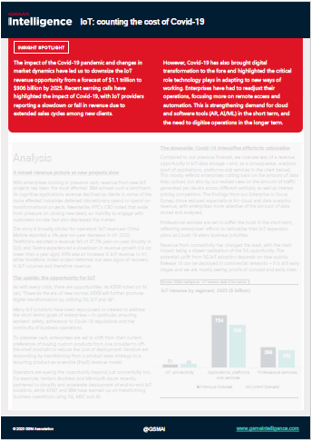
The impact of the Covid-19 pandemic and changes in market dynamics have led us to downsize the IoT revenue opportunity from a forecast of $1.1 trillion to $906 billion by 2025. Recent earning calls have highlighted the impact of Covid-19, with IoT providers reporting a slowdown or fall in revenue due to extended sales cycles among new clients. However, Covid-19 has also brought digital transformation to the fore and highlighted the critical role technology plays in adapting to new ways of working. Enterprises have had to readjust their operations, focusing more on remote access and automation. This is strengthening demand for cloud and software tools (AR, AI/ML) in the short term, and the need to digitise operations in the longer term.
Report details
IoT: counting the cost of Covid-19
Report details
IoT: counting the cost of Covid-19
Related research
India enterprise survey snapshot: charting the digital transformation of enterprises and vertical sectors
B2B has emerged as a strategic growth area for operators and the wider tech/digital ecosystem. As the digital transformation of vertical sectors accelerates, gaining insights directly from enterprises is key. GSMA Intelligence surveyed more than 250 enterprises in India from 10 vertical sectors to gain insight into their digital transformation. The research focused on strategic objectives, investment plans, use of technology, deployment challenges, supplier decisions, tech sovereignty, and policy and regulation.
Asia Pacific enterprise survey: navigating the digital transformation of industries and the B2B opportunity
B2B has emerged as a strategic growth area for operators and the wider tech/digital ecosystem. As the digital transformation of vertical sectors accelerates, gaining insights directly from enterprises is key. GSMA Intelligence surveyed almost 1,500 enterprises from 10 vertical sectors across Asia Pacific to gain insight into their digital transformation. The research focused on strategic objectives, investment plans, use of technology, deployment challenges, supplier decisions, tech sovereignty, and policy and regulation
North America enterprise survey: navigating the digital transformation of industries and the B2B opportunity
B2B has emerged as a strategic growth area for operators and the wider tech/digital ecosystem. As the digital transformation of vertical sectors accelerates, gaining insights directly from enterprises is key. GSMA Intelligence surveyed more than 500 enterprises from 10 vertical sectors across the US and Canada to gain insight into their digital transformation. The research focused on strategic objectives, investment plans, use of technology, deployment challenges, supplier decisions, tech sovereignty, and policy and regulation.
Authors
How to access this report
Annual subscription: Subscribe to our research modules for comprehensive access to more than 200 reports per year.
Enquire about subscriptionContact our research team
Get in touch with us to find out more about our research topics and analysis.
Contact our research teamMedia
To cite our research, please see our citation policy in our Terms of Use, or contact our Media team for more information.
Learn more- 200 reports a year
- 50 million data points
- Over 350 metrics
How can we support you?
Get in touch
Contact the GSMA Intelligence support team for help with your account, subscriptions, or access to reports and insights.
Newsletter
Subscribe to the GSMA Intelligence newsletter for the latest industry news and insights, delivered to your inbox.