
Will Quantum be the next big thing?

Over the past years, it’s been hard to ignore the hype around Artificial Intelligence in the telco space. Operators have poured resource into AI, recognising its game-changing potential not just for network performance but also for everything else, from customer experience to new product launches. But while AI has stolen the spotlight, it’s not the only emerging tech poised to shake things up.
Lately, quantum technology has started edging into the conversation in telco space and beyond and it’s got all to be the next big thing. Tech giants, hyperscalers, and even heavyweight financial players like BlackRock and JP Morgan Chase are already putting serious money behind quantum initiatives. In fact, these institutions have announced billion-pound investments in critical technologies, quantum included, and I reckon this is just the tip of the iceberg.
A look at quantum technologies
When the ecosystem talks about quantum technology, it’s usually referring to three main areas. First, there’s quantum computing, which is all about super-fast and powerful computers that can tackle tough problems traditional computers struggle to solve such as performing big data analysis in just a few seconds. Next, there is quantum communication, which helps keep data in transfer ultra secure, for example when sending a message, making a call or online transactions, making hacking much harder. In the long-term, quantum communication will drive widescale quantum networking, linking distant quantum computers to exponentially boost computational power without losing data in noisy classical channels. Lastly, there’s quantum sensing, which lets us measure things with incredible accuracy, such as temperature or geo location.
Quantum’s potential to revolutionise telco operations
Together, these quantum breakthroughs have the power to radically transform the telco space, unlocking powerful network efficiencies and security as well as new revenue streams. Some operators aren’t just talking about quantum, they’re actually putting it to the test, running pilots and even launching products. So, quantum isn’t just a buzzword anymore, it’s starting to become a reality for telcos. A recent GSMA Intelligence study looked at over 100 operators around the globe and found that 20% have already rolled out Quantum Key Distribution (QKD). Right now, QKD is the most popular quantum use case in the industry, with widespread quantum communication infrastructure emerging across Europe and APAC. Quantum computing and sensing have slower uptake, but are expected to unlock powerful optimisation and new network-integrated sensing capabilities – really boosting future network capability and customer offerings.
QKD is the most developed use case so far
For each of the below quantum technologies, what is the deployment status for your organisation? (Percentage of respondents)
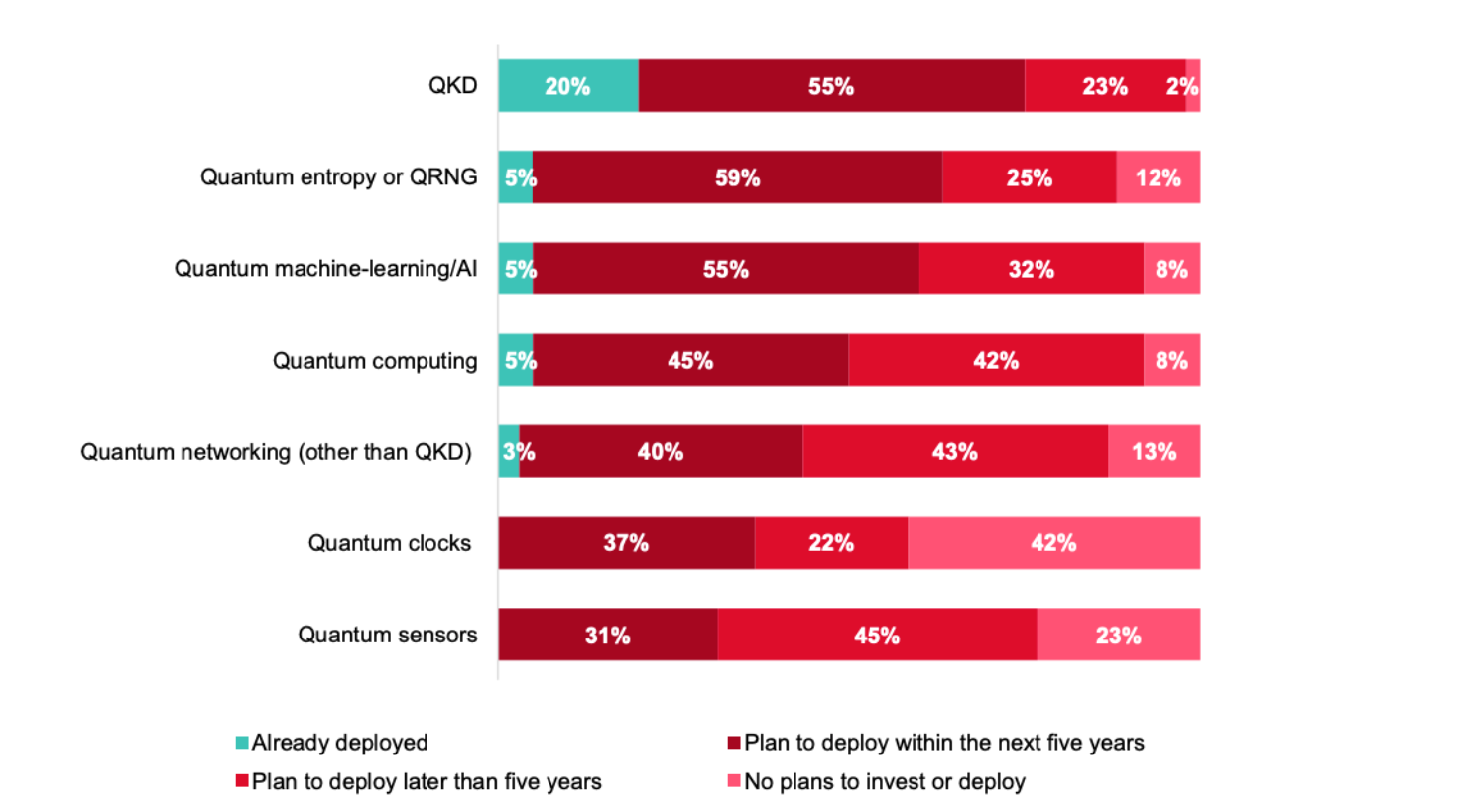
Source: GSMA Intelligence Operator Quantum Survey 2025
But with every tech innovation comes risks
It’s well known that every groundbreaking technology brings opportunities but also risks. When quantum computers will become widely available, their powerful processors and software will be able to break current encryption mechanisms, threatening sensitive data and network security, spanning from core network to devices. A study from GSMA Intelligence estimates that as of today only 8% of global IoT devices are quantum safe. But the most concerning thing, is the pre- quantum computing phase, where cyber criminals are already stealing and storing sensitive data with medium- long life span with the intent to decrypt them when quantum computing will become widely available.
And telcos must be ready for it
The ‘harvest now, decrypt later’ tactic already employed by cybercriminals it’s already threating sensitive data and telcos must be ready to keep data that transit into their network safe.
The main way telcos can achieve better network defences is by implementing Post-Quantum Cryptography (PQC), which relies on complicated mathematical puzzles that even quantum computers can’t solve. QKD, on the other hand, uses the principles of quantum physics to provide information-theoretic security and eavesdropper detection in niche high-assurance applications – but shouldn’t be used as a replacement for PQC.
The costs of (non) action
Let’s be honest upgrading networks for quantum safety isn’t going to be cheap. Operators will need to invest heavily to stay ahead of the curve and build the foundation for new services and products. But, when you look at the bigger picture, the price of doing nothing could be far greater. Just imagine the fallout of hefty fines, a damaged reputation, loss of competitive advantage, and, perhaps most importantly, loss of customer trust. So, is sticking with the status quo really worth the risk?
If you are interested in diving deeper follow GSMA Intelligence research focusing on IoT quantum readiness and operators’ strategic implications of quantum technologies deployments, risks and opportunity costs of non-action where they exist check these reports:
https://www.gsmaintelligence.com/research/iot-in-a-post-quantum-world-coming-sooner-than-you-think
Author
Related reports

- 200 reports a year
- 50 million data points
- Over 350 metrics
How can we support you?
Get in touch
Contact the GSMA Intelligence support team for help with your account, subscriptions, or access to reports and insights.
Newsletter
Subscribe to the GSMA Intelligence newsletter for the latest industry news and insights, delivered to your inbox.