Showing page 9 of 50 - 2304 results
Report
With eSIM penetration in the consumer market set to double in 2026, and double again in 2027, this tracker provides data that operators, OEMs, eSIM vendors and other companies involved in the eSIM value chain, can use to formulate or adjust eSIM commercial strategies and offers. It covers three main areas: the commercialisation of eSIM consumer devices by OEM brand and type of device (smartphone, tablet and smartwatch); countries and MNOs that have launched commercial eSIM service for smartphones; and a consumer adoption forecast for eSIM in the smartphone market to 2030 (global and regional figures).
Video
Sustained cost pressures and commitments to net zero have made energy efficiency a strategic priority for mobile operators, network infrastructure providers and tower companies. Working closely with a global set of mobile operators, GSMA Intelligence leveraged its independent position and analytical capabilities to launch its Energy Efficiency Analysis and Benchmarking project in 2020. The benchmark is based on real-world data inputs and aims to quantify network energy consumption, efficiency levels and fuel sources. For this edition, GSMA Intelligence invited infrastructure providers and tower companies to participate, sharing their data on energy efficiency.
Global Mobile Trends 2026 highlights the opportunities and innovations ahead, as well as the challenges facing the mobile industry and beyond. Covering topics including AI, 5G, autonomous networks, devices, security, quantum, satellites, energy innovation and eSIM, the report focuses on what matters in 2026 and the implications for the industry. The latest edition of Global Mobile Trends delivers expert insights into the key trends that will define the mobile ecosystem in 2026 and beyond. Backed by GSMA Intelligence’s industry-leading research and data, the report provides an authoritative look at the forces shaping the next wave of connectivity and innovation.
Building on previous reports on the evolution of core networks in the 5G-Advanced and AI eras, this report explores what agentic AI means for the mobile core. For the mobile core, most key objectives are unchanged: building future-proof networks that can support a growing and diverse range of endpoints (users, devices and applications) while efficiently delivering intelligent services at scale – all underpinned by a monetisation imperative. But new dynamics have entered the space, from the rise of agentic AI to the sharp focus on sovereignty and mission-critical connectivity. As such, a fresh review of the evolution of mobile core networks is needed.
While there are several indicators and metrics in telecoms, the industry has traditionally lacked a global, comprehensive metric to measure environmental sustainability. In 2025, GSMA Intelligence developed the Green Network Index (GNI), which proposed a single figure to measure the overall environmental sustainability for telecoms networks and help establish a path to greener networks. The second edition of the Green Network Index has expanded to include 138 networks, benchmarking progress at the operator and country levels.
Initially deployed for niche use cases, the entitlement server (ES) has expanded to become the intermediary between mobile network infrastructure and the universe of devices. It authenticates a number of services, including RCS messaging, eSIM, network slices and satellite connectivity. The investment logic for the ES is strengthened by clear cost savings and revenue opportunities post deployment. Operators should consider a strategy for monetisation and identity management based on ES deployment.
The mobile industry underpins global connectivity, enabling seamless communication, real‑time data exchange and an expansive ecosystem of consumer and enterprise applications. While extending ubiquitous connectivity through advanced 4G and 5G networks remains a core priority, the industry is also entering a new era shaped by intelligent, adaptive and value‑added digital services. This shift is being enabled by next‑generation mobile networks, such as 5G standalone architectures, and the rapid integration of AI and other transformative technologies across consumer applications and enterprise solutions.
Case Study
The Green Network Index is a tool for tracking progress on sustainability among telcos and understanding what is driving or holding back progress. The index offers granular data to allow for country and regional comparisons. Alongside the flagship GNI report and index, GSMA Intelligence is releasing a series of company case studies to illustrate innovation in action. This case study highlights how Openserve has taken a leadership position by re-architecting its network energy model, using AI-driven optimisation and renewable energy integration to ensure resilience, affordability and sustainability.
The Green Network Index is a tool for tracking progress on sustainability among telcos and understanding what is driving or holding back progress. The index offers granular data to allow for country and regional comparisons. Alongside the flagship GNI report and index, GSMA Intelligence is releasing a series of company case studies to illustrate innovation in action. This case study highlights how scale and technological sophistication position China Mobile (Guangdong) as both a major energy consumer and a critical testbed for how next-generation networks can be delivered through more energy-efficient and sustainable operating models.
This report analyses the state of 5G, seven years after its commercial launch, using GSMA Intelligence’s 5G Connectivity Index to benchmark 46 markets across 5G infrastructure and services. It shows broad convergence across the foundation components (coverage, affordability, adoption), but reveals a widening gap on advanced capabilities, including 5G standalone (SA), 5G‑Advanced, uplink performance, fixed wireless access (FWA), IoT and RedCap.
Blog
Small and medium-sized enterprises (SMEs) are digitising rapidly, but telcos seize only a fraction of the opportunity due to gaps between SME expectations and current offerings. To unlock growth, telcos must simplify integration, make reliability visible, and shift from offering security tools to managed protection, delivering integrated, outcome-oriented solutions.
Malaysia is emerging as one of Southeast Asia’s most strategically important digital economies, underpinned by strong government support, rising enterprise technology investment and one of the region’s most advanced 5G rollouts. 5G adoption in Malaysia now at around 50% of the mobile customer base, meaning the country has the infrastructure underpinning to drive enterprise transformation.
For the last three years, GSMA Intelligence has run a benchmarking study to analyse progress on the ESG Metrics for Mobile. With 23 mobile operators participating in the latest assessment, the report highlights industry-wide progress and offers data-driven insights into the evolving landscape of ESG reporting in the mobile sector. The 2025 study highlights improvements in reporting and performance across several areas, including GHG emissions and energy consumption. But there remains work to be done elsewhere as gaps persists in metrics related to circularity, digital skills and supply chain assessments.
GSMA Intelligence's Chart of the Month is a visual way of telling an important story in the mobile and broader tech ecosystem. From the shape and size of markets to trends in consumer behaviour, we aim to provide food for thought through informative visuals designed to bring colour and clarity to complex issues facing the industry. This edition looks at capex trends among big tech companies compared to telecoms operators.
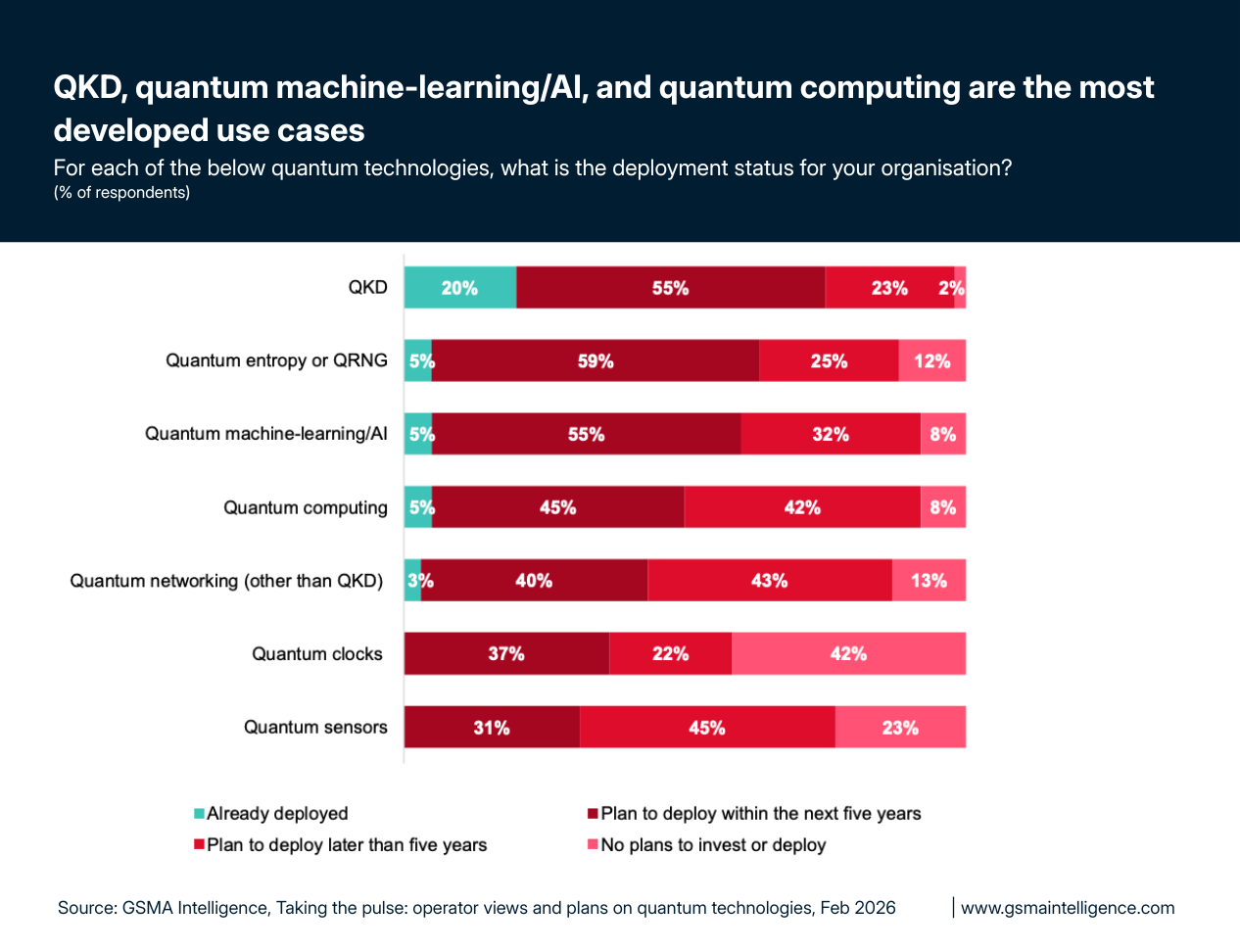
Over the last two years the rise of quantum technologies has flown slightly below the radar, crowded out by the hype of AI. But this should not diminish the implications of quantum technologies for a range of businesses, including telecoms operators. Quantum technologies can provide powerful benefits, including enhanced network security and efficiency. In this report we focus on the strategic implications of quantum technology deployments and the risks of not taking action.
The GSMA Intelligence Mobile Data Deck offers a fast track to all the essential data you need to know, with key mobile metrics in one easy-to-use deck of charts. The forecasts to 2030 include connections by region and technology generation, smartphone connections and adoption, and mobile operator revenue.
Have questions or need support with our reports and data services?