
Getting bang for your buck: telcos and virtual power plants
Access this insight with a Standard plan. Contact our sales team to get started.
Or
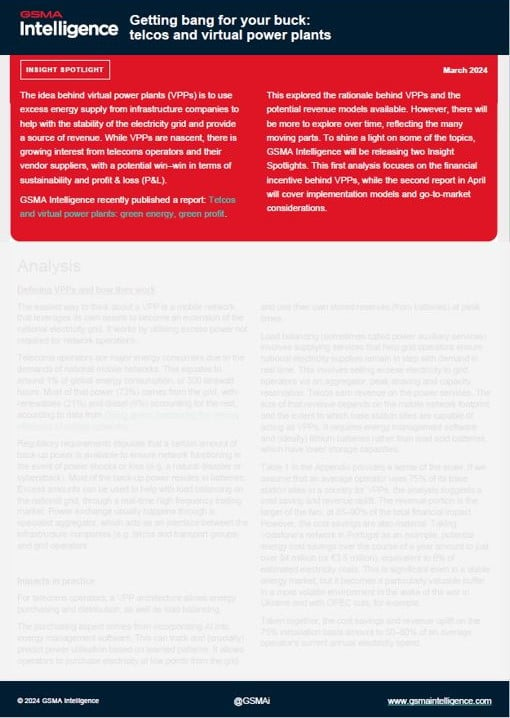
The idea behind virtual power plants (VPPs) is to use excess energy supply from infrastructure companies to help with the stability of the electricity grid and provide a source of revenue. While VPPs are nascent, there is growing interest from telecoms operators and their vendor suppliers, with a potential win–win in terms of sustainability and P&L.
GSMA Intelligence recently published a report: Telcos and virtual power plants: green energy, green profit. This explored the rationale behind VPPs and the potential revenue models available. However, there will be more to explore over time, reflecting the many moving parts. To shine a light on some of the topics, GSMA Intelligence will be releasing two Insight Spotlights. This first analysis focuses on the financial incentive behind VPPs, while the second report in April will cover implementation models and go-to-market considerations.
Report details
Getting bang for your buck: telcos and virtual power plants
More info
This report is one of more than 140 published annually as part of the GSMA Intelligence data and research subscription, which is designed for organisations that require regular access to our insights. Contact our sales team for details.
Contact usReport details
Getting bang for your buck: telcos and virtual power plants
More info
This report is one of more than 140 published annually as part of the GSMA Intelligence data and research subscription, which is designed for organisations that require regular access to our insights. Contact our sales team for details.
Contact usRelated research
The Mobile Economy Canada 2026
Mobile technologies will play a central role in driving Canada’s next phase of economic growth and digital transformation. By 2030, mobile’s contribution is forecast to reach $170 billion, driven by continued adoption of 5G, AI and digital technologies across the economy. Maintaining investment in networks, spectrum and digital infrastructure will be critical to ensuring Canada can fully realise the opportunities of an increasingly connected and AI-driven economy.
Digital Nations 2026: building trusted digital ecosystems in Asia Pacific
Asia Pacific is entering a new phase of digital development. As digital platforms become integral to economic activity, public services, finance, communications and emerging technologies such as AI, trust becomes a critical enabler of digital transformation. This report examines the trust imperative across Asia Pacific, examines the results of the Digital Nations Index in the context of trust, outlines the role of mobile operators as guardians of digital trust, and presents priorities for strengthening the foundations of digital trust for governments, regulators, operators and international cooperation institutions.
Closing the Mobile Connectivity Gap in Developing Asia and the Pacific
Developing Asia Pacific is home to 4.3 billion people – more than half the world’s population. However, 1.2 billion people are not online. Achieving universal connectivity by 2030 will require additional investment of around $184 billion. The economic case for closing this gap is significant. Closing the 4G connectivity gap by 2030 is estimated to deliver a GDP uplift of around $230 billion across Developing Asia Pacific. Universal connectivity would also have several wider socioeconomic benefits such as poverty reduction, improved education and health access, humanitarian assistance and lower carbon emissions. This report presents the findings from a study by GSMA Intelligence on closing the mobile connectivity gap in Developing Asia Pacific, commissioned by the Asian Development Bank.
Authors
How to access this report
Annual subscription: Subscribe to our research modules for comprehensive access to more than 200 reports per year.
Enquire about subscriptionContact our research team
Get in touch with us to find out more about our research topics and analysis.
Contact our research teamMedia
To cite our research, please see our citation policy in our Terms of Use, or contact our Media team for more information.
Learn more- 200 reports a year
- 50 million data points
- Over 350 metrics
How can we support you?
Get in touch
Contact the GSMA Intelligence support team for help with your account, subscriptions, or access to reports and insights.
Newsletter
Subscribe to the GSMA Intelligence newsletter for the latest industry news and insights, delivered to your inbox.