
How many OTT partners do pay-TV operators really need in 2026?

For most consumers today, watching TV no longer means navigating between channels. It means navigating apps, subscriptions, passwords, and monthly charges. Streaming has expanded choice, but it has also made managing that choice harder. This is where OTT bundling enters the picture to ease on these consumer challenges.
Across global pay-TV markets, we track at GSMA Intelligence, bundling with streaming platforms, has shifted from being an optional add-on to becoming a core part of the TV offering. It is not about competing with OTT services, but about adding value to the customers. This shift has accelerated over the past year as operators respond to rising subscription complexity and consumer fatigue. The key question, then, is no longer if operators bundle OTT services, but how many services are actually useful to the customer as part of the bundling and create value for them.
Why does bundling exist in the first place?
The logic behind OTT bundling is straightforward. As consumers subscribe to more streaming platforms, the time and effort required to manage those subscriptions also increases.
Bundling responds to this challenge in three ways. It reduces friction by bringing services under a single relationship. It simplifies discovery by packaging content together rather than leaving users to assemble their own combinations. And it improves perceived value, particularly in markets where pricing pressure is high.
Seen through this lens, pay-TV and OTT partnerships are less about content expansion and more about customer retention by reducing the burden of choice and generating perceived value. That is why bundling has become central to the modern pay-TV proposition.
So, what does “normal” look like in 2026?
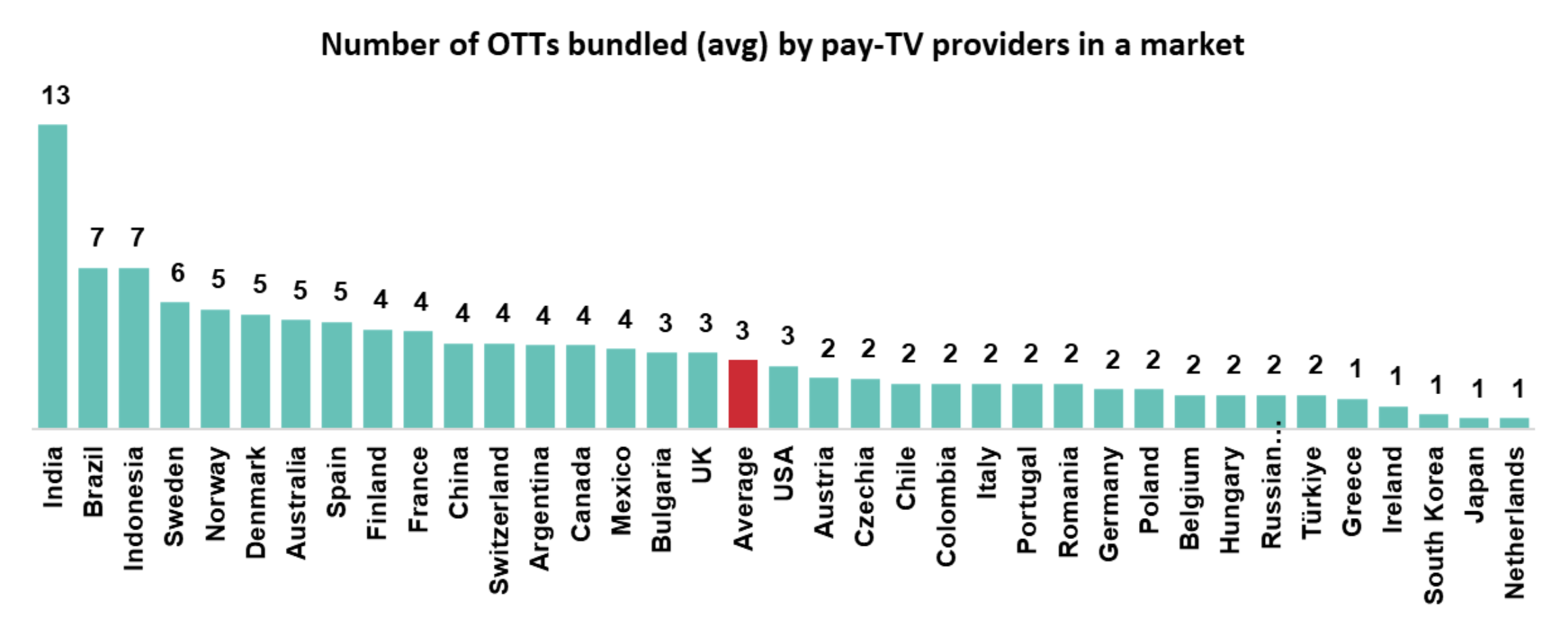
Source : GSMA Intelligence pay-TV and OTT tracker
The chart above shows the average number of OTT platforms bundled per pay-TV operator, broken down by country.
When you look across markets, a clear pattern emerges. On average, pay-TV operators bundle around three to four OTT services, globally. This is a useful anchor point. Despite the rapid growth in the number of streaming platforms globally, most operators are not trying to offer everything. Instead, they are converging on a level of choice that feels manageable for customers, at a time when subscription fatigue is becoming increasingly visible.
In other words, the market appears to be settling on a definition of “what number is good enough for bundling”. The variation, however, in number of OTT services bundled by pay-TV operators in every market is reflective of the variation in market forces driving the bundling strategy.
India stands out clearly in the chart, with pay-TV operators (bigger players including Vi, Airtel, Reliance Jio) bundling a significantly higher number of OTT platforms on average. It reflects local market dynamics, particularly high price sensitivity, massive distribution these telcos cum pay-TV operators are able to offer.
In these environments, broad OTT bundles allow operators to position pay-TV as a one stop destination. Rather than asking customers to assemble, manage, and pay for their subscription, bundling reduces the friction and gives a feeling of free, particularly important in price-sensitive customer markets. In markets such as the UK, streaming adoption is already widespread, which shapes a very different bundling rationale. Ofcom data shows that 68% of UK households had at least one SVoD subscription as of Q1 2025, with around two‑thirds subscribing to at least one of Netflix, Prime Video, or Disney+. In this context, OTT bundling is less about introducing streaming to new users and more about simplifying life for households that are already deeply embedded in OTT viewing. Pay-TV operators therefore tend to focus on a small set of widely used platforms, rather than full spectrum of OTTs platforms.
The dynamics are different again in markets like Japan and South Korea, where historical reliance on strong local content ecosystems has shaped bundling choices. In Japan, pay-TV penetration remains relatively low, and consumer preference skews heavily toward domestic content. As a result, operators have traditionally focused on promoting their own OTT platforms and locally produced content rather than bundling multiple big international platforms, keeping average OTT partnerships quite limited. South Korea’s pay-TV market is more mature, but local platforms have similarly played a central role, reflecting strong demand for domestically produced content. While this has historically supported smaller bundles, the model is now evolving.
Taken together, these markets highlight a common theme: the right number of OTT partners is shaped less by what is available in the market and more by how consumers engage with streaming. Whether through breadth, balance, or simplicity, bundling strategies are ultimately designed to reflect local expectations around value, convenience, and content relevance.
Looking ahead
If the average pay-TV operator bundles with three to four OTT services today, the next question is obvious: which OTT platforms are most consistently part of that core bundle, and why?
That question moves the conversation from how many to which ones matter most. It is also where the next phase of pay-TV OTT collaboration will take shape.
We have explored more detail on this in our FTVC quarterly deliverable Pay-TV Markets, Q4 2025: developments and outlook | GSMA Intelligence
Author

- 200 reports a year
- 50 million data points
- Over 350 metrics
How can we support you?
Get in touch
Contact the GSMA Intelligence support team for help with your account, subscriptions, or access to reports and insights.
Newsletter
Subscribe to the GSMA Intelligence newsletter for the latest industry news and insights, delivered to your inbox.