
Fixed broadband today: where growth, technology and strategy are meeting

In our recent GSMA Intelligence webinar on fixed broadband trends, outlook, and commercial strategies, we discussed how the fixed broadband market is evolving across regions and technologies.
In many mature markets, overall growth is slowing. Penetration is already high, and adding new households is slower. But that does not mean the market is standing still. What is changing is where the focus sits, with operators increasingly looking at network evolution, service upgrades, and new ways to create value.
Across regions, fixed broadband is increasingly about network evolution, technology choices, and commercial strategies that make sense in very different local contexts.
A market that feels familiar, but is built differently
One helpful way to look at where fixed broadband is heading is to step back and compare it with where the market was before.
In the past, legacy copper networks sat at the centre of fixed broadband. These networks were originally designed to deliver voice services, with DSL later enabling broadband services over the same copper infrastructure. In many countries, this reflected the historical legacy of national telecoms networks, where copper-based PSTN networks had already reached a large share of homes.
Today, fibre is taking on that same central role. The core use case has shifted from voice to broadband access, and fibre is much better suited to supporting higher speeds, greater reliability, and growing digital usage inside the home.
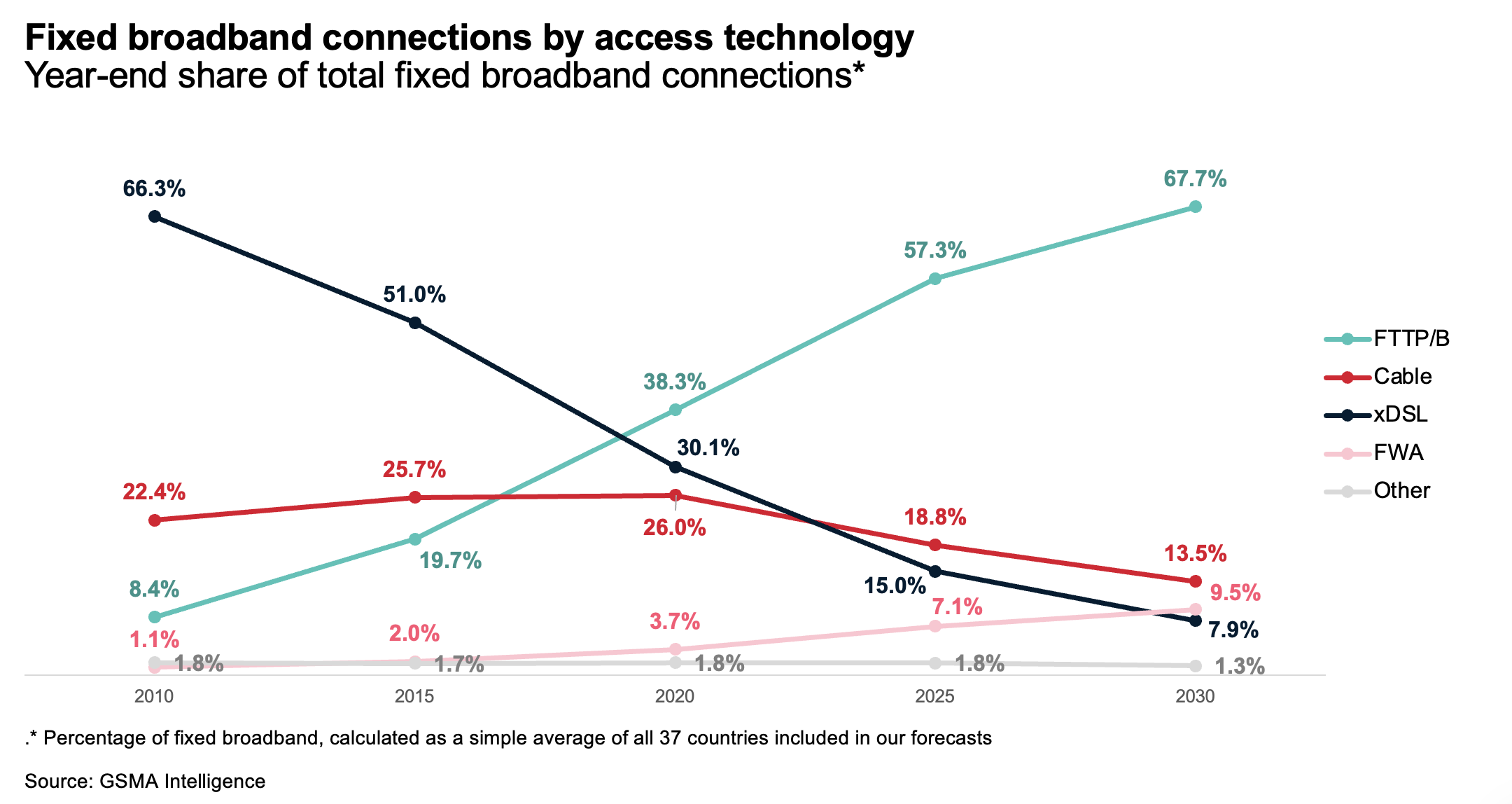
Across the large fixed broadband markets we track, fibre is becoming the backbone of connectivity in many of them. This shift explains why copper network shutdowns are no longer just long-term ambitions. In several markets, operators now have defined migration paths and timelines to move customers onto newer networks. In some markets, such as the EU, these migration and transition plans are driven by regulation.
In that sense, the market structure looks familiar. What has changed is the foundation underneath it.
Fibre leads, but multiple technologies still matter
While fibre is increasingly dominant, it is not the only technology shaping the fixed broadband landscape.
In many markets, 5G FWA (Fixed Wireless Access) has become an important part of the mix. It is often used where fibre rollout is slower, or less economical. In some cases, it is the primary fixed broadband connection, while in others it plays a role as backup connectivity or for specific use cases.
Satellite broadband is also becoming more relevant again, particularly with new LEO (low earth orbit) systems, which offer significantly higher speeds and lower latency than previous services based on geostationary satellites. These emerging services are not replacing fibre or wireless networks at scale, but they are complementing them, extending broadband access to locations that remain difficult to serve through other technologies.
Rather than one technology replacing another, what we see is a more layered broadband market, where different solutions address different needs.
From expansion to upgrades and value
Another clear shift is how operators approach growth.
In mature markets especially, the opportunity is less about first‑time connections and more about upgrades. This includes higher speeds, better reliability, and improving the in‑home experience.
One notable trend is that the difference in speed between broadband tiers is often much larger than the difference in price. This plays an important role in encouraging customers to move to faster packages, even when overall market growth is limited.
Operators are also experimenting beyond just connectivity. Bundling has been part of fixed broadband strategies for many years, but what is changing is the type and structure of bundles being offered. Operators are increasingly experimenting with new services such as AI subscriptions, energy services, and connected devices, including XR headsets. At the same time, some providers are moving away from rigid, preset bundles towards more flexible propositions that allow customers to manage multiple subscriptions through a single operator-provided interface.
A market shaped by local realities
There is no single global model for success in fixed broadband.
In emerging markets, expanding coverage and affordability remain key priorities. In mature markets, reliability, customer experience, and efficient upgrades are increasingly important. The balance between building networks, partnering with others, or acquiring assets also varies significantly from one country to another.
What works well in one market may not translate directly to another. That is why understanding local conditions and technology fit is becoming more important than simply increasing network scale.
Looking ahead
Fixed broadband is moving into a phase where network transition, technology mix, and commercial design matter more than subscriber growth.
These themes were explored in recent discussions in our latest GSMA Intelligence webinar.
For further insight, including detailed forecasts, market tracking, and operator case studies, our latest fixed broadband research is available on the GSMA Intelligence platform here Fixed broadband and fixed wireless access (FWA) | GSMA Intelligence.
Author

- 200 reports a year
- 50 million data points
- Over 350 metrics
How can we support you?
Get in touch
Contact the GSMA Intelligence support team for help with your account, subscriptions, or access to reports and insights.
Newsletter
Subscribe to the GSMA Intelligence newsletter for the latest industry news and insights, delivered to your inbox.