
Amazon’s Acquisition of Globalstar: What does it mean for XCOM RAN, Globalstar's private 5G business

Yesterday, Amazon announced the acquisition of Globalstar for approximately $11.57 billion, including its satellite operations, infrastructure, assets and MSS spectrum licences. The deal is expected to close in 2027 and is aimed at accelerating Amazon Leo (formerly Project Kuiper), Amazon’s satellite broadband initiative. A more detailed take by GSMA Intelligence on the satellite angle can be found here.
The Private Networks Dimension: XCOM RAN
While satellite and spectrum assets will dominate coverage of this deal, a less discussed but strategically relevant asset is also moving to the hands of Amazon’s: Globalstar’s terrestrial private wireless business under the XCOM RAN brand.
More specifically, with the acquisition of Globalstar, Amazon is also acquiring a private 5G business, one that comes with dedicated spectrum, controlled network infrastructure and a full commercial stack.
Some background on this.
XCOM RAN was formally launched on April 7, 2026, just one week before the Amazon acquisition announcement, and, as such, it should be understood as a newly commercialised product. That said, its underlying architecture and technical depth is substantive.
Built on O-RAN standards, XCOM RAN centres on a “Supercell” design intended to reduce the need for manual site surveys and RF planning, addressing a key friction point in private 5G deployment. Target sectors include warehouse automation, manufacturing, logistics, ports and mining (environments characterised by dense RF conditions, high uptime requirements) and areas with increasing deployment of robotics and autonomous systems in both indoor and outdoor scenarios.
The solution comprises three core components: the XCOM Radio Series (indoor and outdoor units), the XCOM Core (interoperable with third-party cores) and the XCOM Orchestrator, a multi-tenant management and orchestration platform.
A key differentiator is spectrum flexibility across three bands:
- Band n48 (US CBRS, 3550–3700 MHz): shared private network deployments in the United States
- Band n78 (3.5 GHz): licensed industrial 5G deployments across Europe and parts of Asia
- Globalstar’s licensed Band n53 (2483.5–2495 MHz): dedicated licensed private spectrum by Globalstar – a key differentiator - currently available in 13 countries
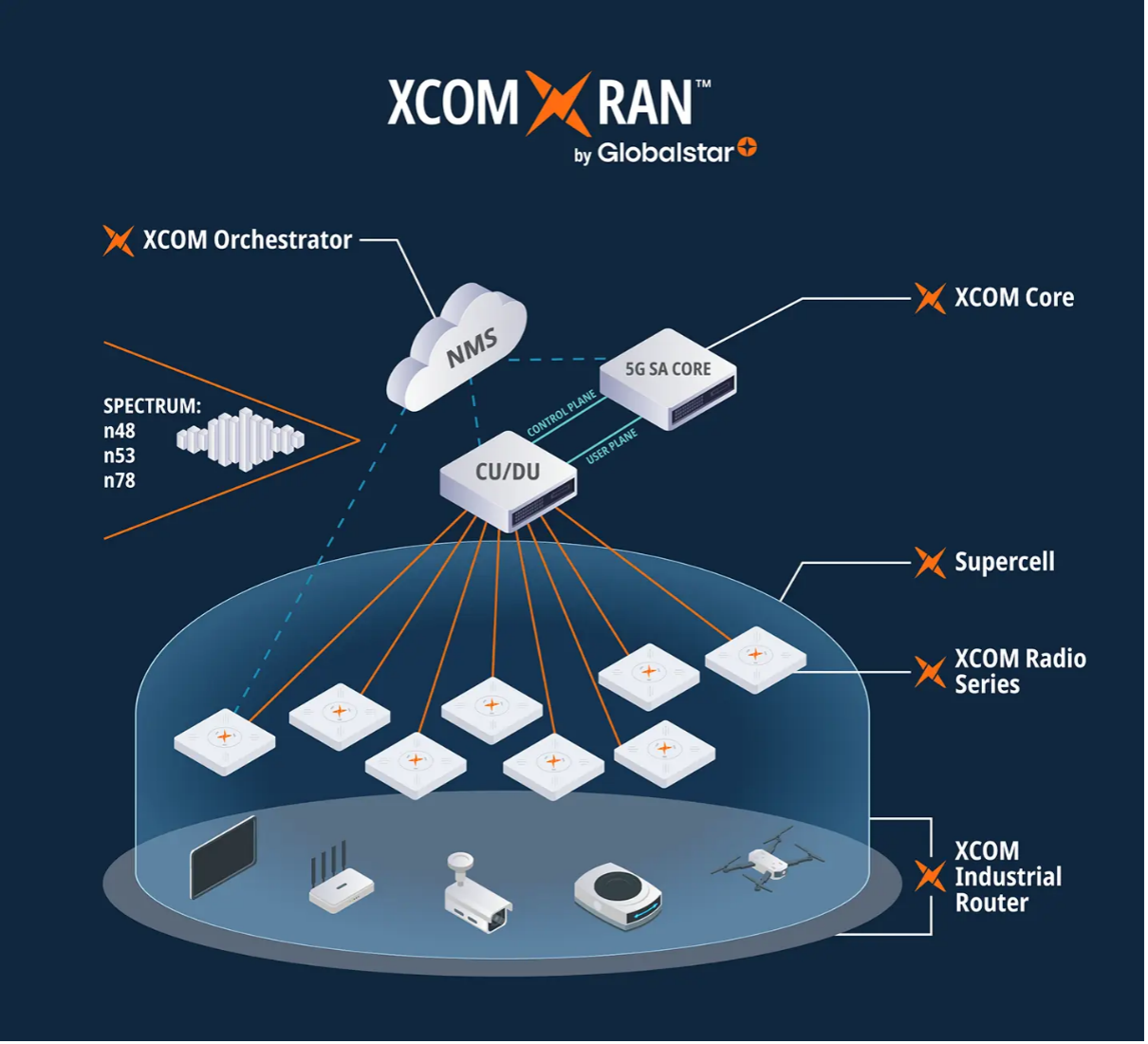
The XCOM Industrial Router, an Industry 4.0 CPE device supporting all three bands, enables integration into AI-driven industrial automation environments.
As a fully end-to-end private 5G offering, XCOM RAN combines software, radio, core, orchestration and proprietary terrestrial spectrum, that is Band n53 which is a strategically distinctive element, enabling interference-free, dedicated capacity for enterprises.
Go-to-market partners include Boldyn Networks, Nextivity, Rajant and Zebra Technologies, covering DAS systems, mesh networking and ruggedised enterprise hardware. Zebra has already added Band n53 support to its ET401 enterprise tablets.
AWS Private 5G: Launch, Failure and Relevance to the Globalstar Deal
Amazon Web Services had launched AWS Private 5G in November 2021 as a managed service enabling enterprises to deploy private mobile networks. Early customers included DISH, Amazon fulfilment centres and Koch Global Services. The service was quietly discontinued in May 2025. AWS cited limited spectrum availability and reliance on third-party hardware as key constraints.
As XCOM RAN private 5G solution includes both spectrum ownership and hardware control, it is, in theory, addressing the missing components that previously constrained Amazon’s private 5G attempt.
An Open Question for Post-Acquisition Strategy
There is no doubt that the primary rationale for the Amazon-Globalstar deal is satellite spectrum acquisition and direct-to-device (D2D) capability. XCOM RAN is therefore an ancillary, not core, driver of the transaction. This presents a risk that a strategically valuable asset becomes deprioritised or absorbed into a business built around a different objective.
Amazon should avoid that risk and take advantage of the full capabilities it is acquiring. XCOM RAN underlying solution is technically robust, supported by a strong partner ecosystem and benefits from a meaningful integration runway through 2027 and beyond. Most importantly, XCOM RAN brings committed leadership, a focused execution team and real traction in private networks, assets that are difficult to build from scratch and easy to lose through neglect.
In the near term, the priority for Globalstar should be to scale XCOM RAN as a standalone business, including potential deployment across Amazon’s own logistics and warehousing footprint.
After 2027, once post-merger integration begins, there may be a credible case for positioning XCOM RAN within a broader Amazon connectivity stack spanning satellite broadband (Leo), D2D MSS, and private industrial 5G networks. While it’s too early to draw conclusions about best strategy in the longer run, this scenario might mean the private networking platform loses strategic focus – buyers of satellite solutions rarely have overlapping needs with buyers of private 5G networks.
The outcome will depend on two things: XCOM RAN leadership maintaining its commercial focus and Amazon recognising the full value of what it has acquired.
This remains an area to watch closely.
Author

- 200 reports a year
- 50 million data points
- Over 350 metrics
How can we support you?
Get in touch
Contact the GSMA Intelligence support team for help with your account, subscriptions, or access to reports and insights.
Newsletter
Subscribe to the GSMA Intelligence newsletter for the latest industry news and insights, delivered to your inbox.